Private file sharing services checklist for secure data transfer
True confidentiality requires examining metadata retention and zero-knowledge encryption keys rather than relying on standard password protection.

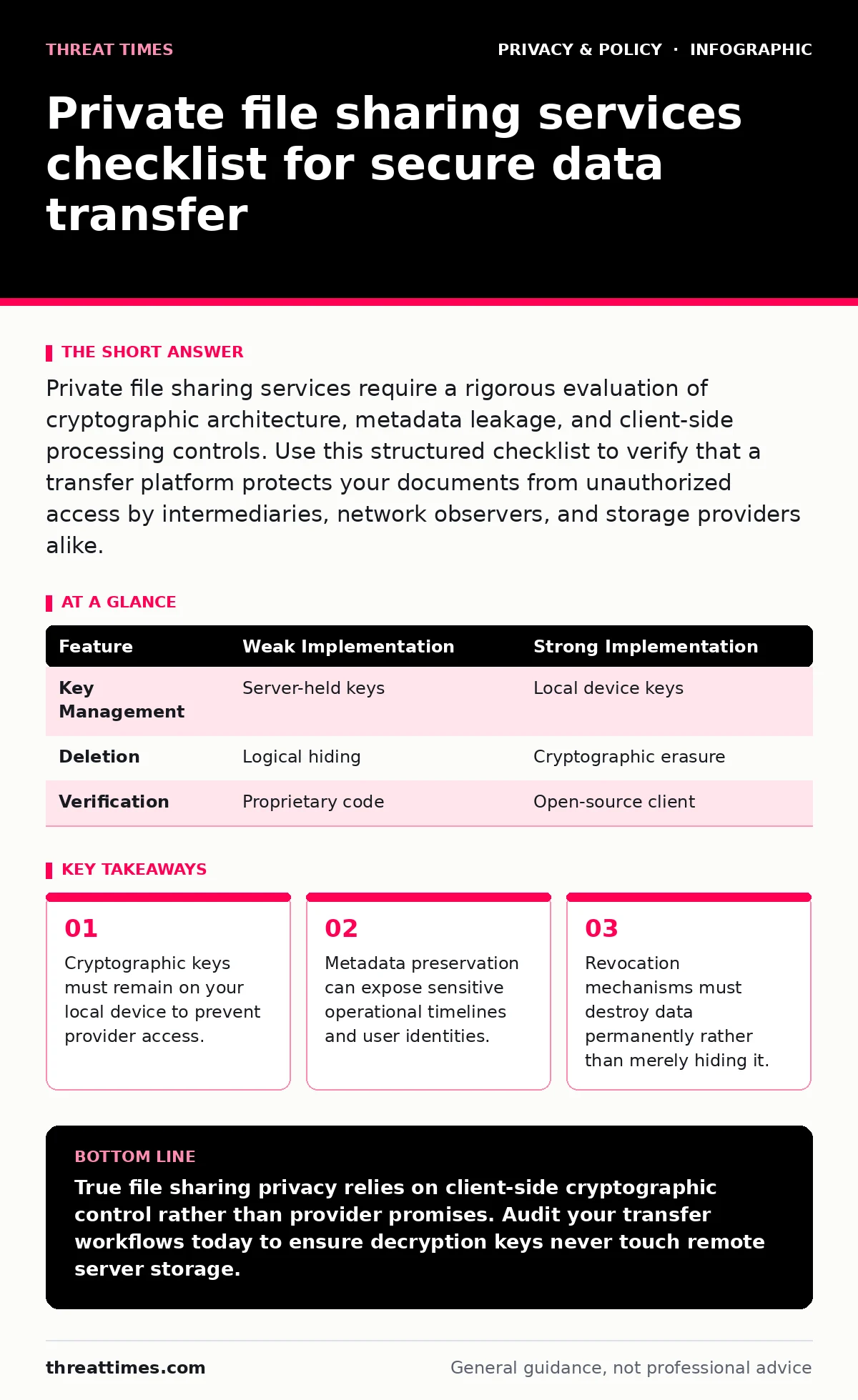
Private file sharing services require a rigorous evaluation of cryptographic architecture, metadata leakage, and client-side processing controls. Use this structured checklist to verify that a transfer platform protects your documents from unauthorized access by intermediaries, network observers, and storage providers alike.
Understanding the Transfer Architecture and Trust Model
Private file sharing services rely on specific trust assumptions that dictate how safely your data moves across public networks. You must evaluate whether a platform uses end-to-end encryption, which ensures that data is scrambled on your device and can only be unscrambled by the intended recipient. Service providers often market secure transfers, but many retain decryption keys on their servers, creating a single point of failure if their infrastructure suffers an intrusion.
- Client-side encryption: ensures keys never leave local hardware during the entire transfer lifecycle.
- Open-source client code: allows independent security researchers to verify the underlying cryptographic implementation.
- Zero-knowledge architecture: guarantees the hosting company cannot read file contents even under legal compulsion.
- Transport layer security: protects data in transit against interception by intermediate network routing nodes.
Evaluating Metadata and Network Footprint Controls
File sharing platforms often leak contextual details that compromise operational security long before anyone opens the actual document. Every upload generates timestamps, file sizes, and network addresses that observers can aggregate to map communication patterns. When evaluating these platforms, you should review how they handle third-party cookies and tracking scripts embedded in their web interfaces, as these elements can link your identity directly to the shared resource.
- IP address logging minimization: prevents the service from recording sender and receiver routing origins permanently.
- Stripping embedded metadata: removes device identifiers, author names, and editing histories from files automatically upon upload.
- Anonymous payment options: allows subscription funding without linking credit card records to personal identity profiles.
- Traffic obfuscation: masks payload sizes and connection durations to frustrate traffic analysis techniques.
Configuring Access Restrictions and Expiration Rules
Transfer security depends heavily on how strictly you can govern access after the initial upload completes. A service that lacks automated destruction routines leaves dormant files exposed indefinitely on remote servers. You must ensure that links expire based on strict time limits or access counts, and that recipients must authenticate themselves through secondary channels before retrieval begins.
- Self-destruct timers: ensure files vanish permanently from remote storage after a predetermined duration.
- Download count limits: restrict file retrieval to a fixed number of successful transfers before link termination.
- Password protection: requires recipients to enter a pre-shared secret distinct from the delivery link.
- Two-factor authentication: verifies recipient identity before releasing decryption materials to the endpoint device.
Auditing Storage Persistence and Deletion Integrity
Digital transience is notoriously difficult to achieve once data touches managed cloud infrastructure. Many platforms merely remove references to files in user interfaces while retaining the underlying ciphertext in backup archives indefinitely. You need to confirm that deletion routines execute physical overwrites across distributed storage clusters rather than simple logical unlinking.
- Cryptographic erasure: destroys the unique decryption key instantly, rendering the stored ciphertext permanently unrecoverable.
- Storage jurisdiction compliance: aligns server physical locations with regional data protection mandates.
- Independent security audits: validates that deletion claims match actual backend storage behavior.
- Automated purging of abandoned uploads: clears unfinished transfer sessions without retaining orphaned fragments.
| Feature | Weak Implementation | Strong Implementation |
|---|---|---|
| Key Management | Server-held keys | Local device keys |
| Deletion | Logical hiding | Cryptographic erasure |
| Verification | Proprietary code | Open-source client |
Managing Endpoint Risks and Recipient Environments
The security of a private transfer collapses if the receiving device is already compromised or improperly configured. Sharing sensitive documents requires you to consider whether the recipient's environment exposes the payload to unauthorized third parties, such as mobile app permission abuse on poorly vetted smartphones. You should also ensure that file previews do not cache unencrypted versions in browser local storage where local users can access them.
- Direct streaming options: allows viewing without saving permanent copies to the recipient's local disk.
- Device fingerprinting defense: prevents tracking recipients across different networks during retrieval.
- Viewer restrictions: disables printing, copying, and screen capture capabilities within the viewing interface.
- Sandbox isolation: runs document renderers in restricted environments to contain potential parser exploits.
Preparing for Policy Changes and Vendor Shifts
Cloud services frequently alter their terms of service, ownership structures, or data retention practices without direct notification to users. Relying on a single provider for sensitive workflows creates operational vulnerability when corporate policies shift or companies experience acquisition. You should regularly review privacy policies and data handling disclosures to detect subtle modifications in how platforms share operational telemetry or cooperate with external entities.
- Data portability tools: enables rapid migration of active transfer links to alternative infrastructure providers.
- Clear retention disclosures: explicitly details how long logs persist after account termination.
- Version history transparency: tracks modifications to platform security frameworks and privacy commitments over time.
- Incident notification speed: mandates immediate alerts if storage integrity is ever compromised.
Key takeaways
- Cryptographic keys must remain on your local device to prevent provider access.
- Metadata preservation can expose sensitive operational timelines and user identities.
- Revocation mechanisms must destroy data permanently rather than merely hiding it.
True file sharing privacy relies on client-side cryptographic control rather than provider promises. Audit your transfer workflows today to ensure decryption keys never touch remote server storage.
Frequently asked questions
Can a file sharing service read my documents if they use end-to-end encryption?
True end-to-end encryption prevents the service provider from reading your documents because the encryption and decryption keys reside exclusively on your local device. If the provider manages the keys or handles the encryption process on their servers, they retain the technical capability to inspect your files.
Why does metadata matter more than the file contents in some sharing scenarios?
Metadata reveals operational patterns, communication frequencies, and device identifiers that can compromise your digital footprint even when the file contents remain strictly encrypted. Attackers often analyze this surrounding data to map relationships and timing without needing to break the underlying file security.
What happens to a file after it reaches its download limit on a secure platform?
A secure platform should execute cryptographic erasure by destroying the unique key required to decrypt the ciphertext stored on its servers. This renders the remaining data permanently unreadable, even if the physical bits linger on a hard drive pending disk sector reuse.
How do I know if a private file sharing service actually deletes my data?
You can verify deletion integrity by checking whether the platform relies on open-source infrastructure, undergoes regular third-party security audits, and provides transparent documentation regarding its cryptographic destruction methods. Proprietary systems that obscure their backend operations offer no verifiable proof of complete data removal.
How this guide was produced: written by the Threat Times editorial team with AI assistance, checked against the public references listed below, and reviewed when the facts change. See our editorial policy or report an error.