LLM guardrails best practices for production reliability
Large language model guardrails fail when they rely solely on the primary model to police its own output during generation.

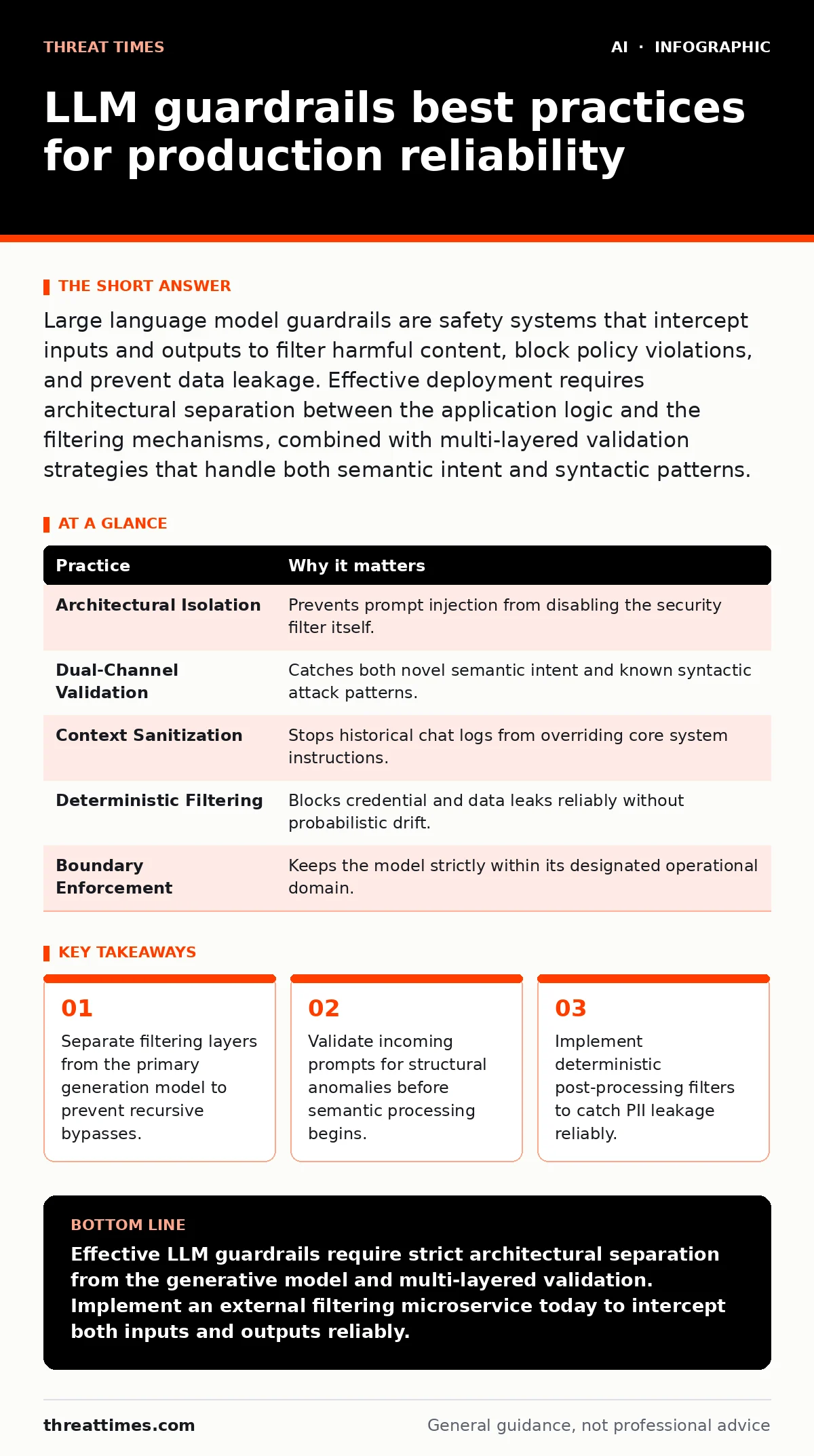
Large language model guardrails are safety systems that intercept inputs and outputs to filter harmful content, block policy violations, and prevent data leakage. Effective deployment requires architectural separation between the application logic and the filtering mechanisms, combined with multi-layered validation strategies that handle both semantic intent and syntactic patterns.
Architectural Isolation of Safety Filters
Guardrail systems must operate outside the primary large language model process to ensure uncompromised oversight. Running safety checks inside the same context window allows malicious inputs to manipulate the monitoring instructions alongside the generative tasks. Externalizing validation creates a strict trust boundary where dedicated secondary processors inspect payloads independently.
Isolate filtering logic into stateless microservices that communicate with the main application through rigid API contracts. This separation ensures that an injection attack succeeding against the primary conversational agent cannot rewrite the rules enforced by the monitoring layer.
Dual-Channel Input Validation
Incoming prompts require both semantic classification and structural pattern matching before reaching the primary model. Semantic classifiers detect prohibited intents disguised through creative phrasing, while deterministic regex patterns catch known attack signatures instantly. Relying purely on embedding-based classifiers leaves applications vulnerable to novel token-level obfuscation techniques.
Implement a scoring pipeline that aggregates results from multiple detection engines before permitting execution.
Context Window Sanitization
Conversational history accumulates untrusted data that can gradually erode safety boundaries over extended interaction sessions. System instructions buried deep within long chat logs often lose authority as the context fills with user-supplied text. Strip historical turns of formatting tokens that mimic system instructions before appending them to current requests.
Truncate historical payloads aggressively and re-inject core security policies at the final boundary layer.
Deterministic Output Filtering
Generated responses require rigid post-processing rules to prevent unauthorized data disclosures before they reach the user interface. Probabilistic safety checks on outputs often miss subtle formatting tricks or encoded secrets hidden within generated code blocks. Apply deterministic scanners that scan every outgoing token stream for specific organizational identifiers and credentials.
Block any response containing unauthorized patterns immediately without attempting to rewrite or sanitize the offending text dynamically.
Semantic Boundary Enforcement
Semantic boundaries define the acceptable domain of discourse for a deployed conversational interface. General-purpose models wander outside intended use cases unless constrained by explicit topical classifiers operating outside the main weights. These boundaries prevent the system from offering medical, legal, or financial advice when deployed in unrelated enterprise sectors.
Train secondary classification models specifically on your domain taxonomy to evaluate user intent independently of the primary model's conversational fluency.
Rate Limiting and Behavioral Tracking
Adversaries probe filtering systems systematically through automated scripts to map boundaries and discover bypass vulnerabilities. Static rate limits fail to catch distributed probing campaigns that rotate parameters slowly across multiple sessions. Monitor behavioral anomalies across user sessions to detect automated reconnaissance patterns before extraction succeeds.
Track frequency, token length, and semantic variance per user identity to flag systematic boundary testing.
Fallback and Graceful Degradation
Safety interventions must fail securely without exposing internal system states or raw error messages to the user. When a guardrail service encounters a timeout or internal fault, default application behavior should reject the request entirely. Revealing stack traces or validation logic during failures provides attackers with valuable feedback for crafting bypasses.
Design fallback mechanisms that return standardized, uninformative refusal messages whenever validation pipelines experience interruptions.
| Practice | Why it matters |
|---|---|
| Architectural Isolation | Prevents prompt injection from disabling the security filter itself. |
| Dual-Channel Validation | Catches both novel semantic intent and known syntactic attack patterns. |
| Context Sanitization | Stops historical chat logs from overriding core system instructions. |
| Deterministic Filtering | Blocks credential and data leaks reliably without probabilistic drift. |
| Boundary Enforcement | Keeps the model strictly within its designated operational domain. |
Continuous Adversarial Testing
Static test suites become obsolete rapidly as users discover novel ways to manipulate language model outputs. Automated red teaming pipelines should bombard your integration layers continuously with generated adversarial variations. This practice mirrors the techniques explored in generative AI evaluations to uncover hidden weaknesses before public deployment.
Integrate automated prompt mutation engines into your continuous integration pipelines to test guardrail resilience against semantic drift.
Key takeaways
- Separate filtering layers from the primary generation model to prevent recursive bypasses.
- Validate incoming prompts for structural anomalies before semantic processing begins.
- Implement deterministic post-processing filters to catch PII leakage reliably.
Effective LLM guardrails require strict architectural separation from the generative model and multi-layered validation. Implement an external filtering microservice today to intercept both inputs and outputs reliably.
Frequently asked questions
How do you stop users from jailbreaking a large language model through roleplay scenarios?
Intercept prompts that attempt to establish hypothetical framing and evaluate the underlying semantic intent rather than the surface narrative.
What causes guardrail latency to degrade production application performance?
Running heavy neural network classifiers synchronously within the main request path adds significant overhead to every single token generation cycle.
Can open-source safety models match commercial guardrail APIs in enterprise settings?
Open models offer complete data privacy and customization control, but require significant in-house engineering effort to match the scale of commercial offerings.
How do you handle false positives that block legitimate user requests?
Establish a secondary review queue for flagged interactions and use those edge cases to retrain your classification thresholds iteratively.
How this guide was produced: written by the Threat Times editorial team with AI assistance, checked against the public references listed below, and reviewed when the facts change. See our editorial policy or report an error.