Checking if your email was in a breach and what to do next
Discovering your address inside a public leak database rarely means immediate compromise, but it permanently changes your threat model.
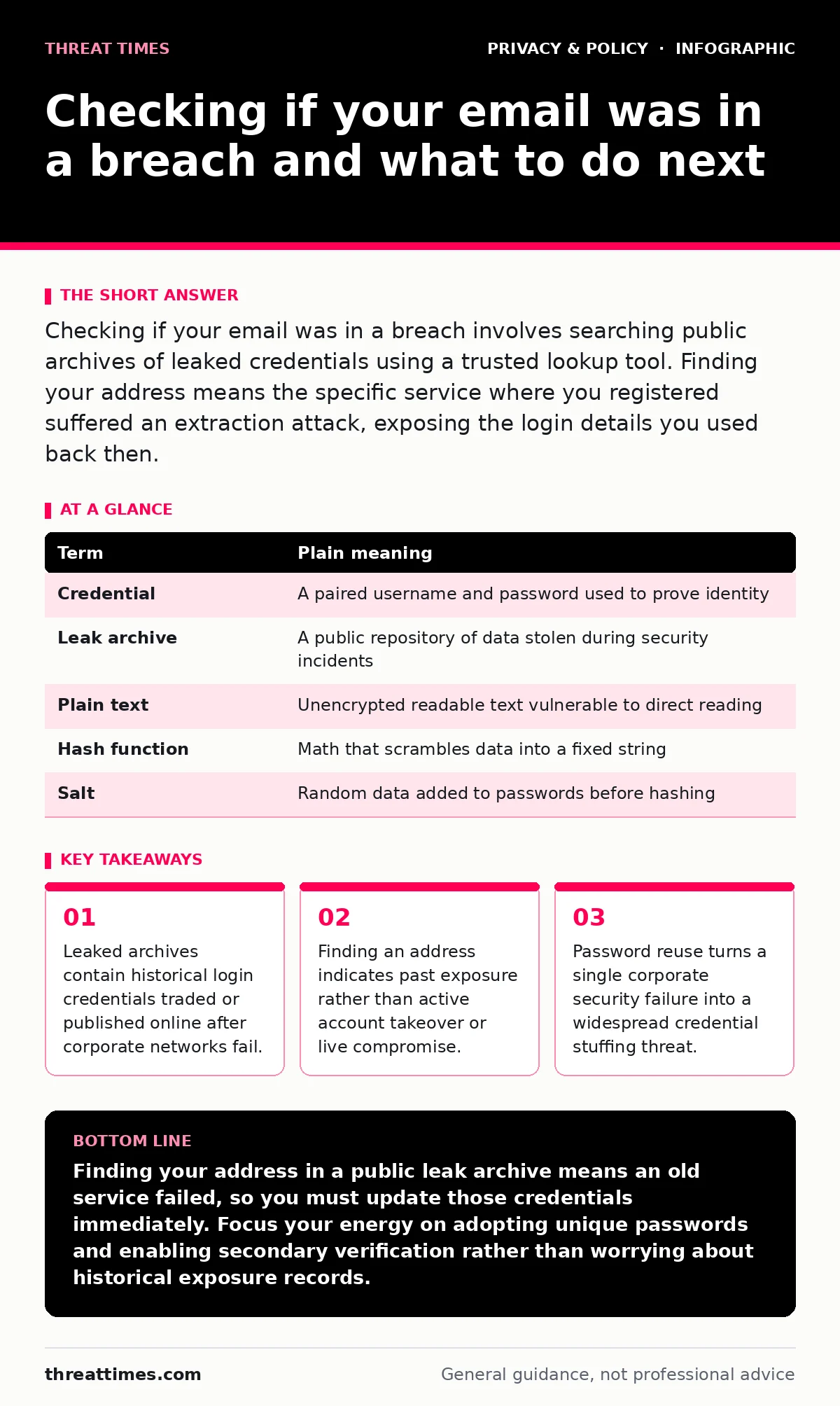
Checking if your email was in a breach involves searching public archives of leaked credentials using a trusted lookup tool. Finding your address means the specific service where you registered suffered an extraction attack, exposing the login details you used back then.
Understanding the Postcard Analogy
Imagine writing your home address and private messages on the back of an open postcard before mailing it. Anyone sorting the mail or handling the delivery sack can read every word without opening an envelope. Digital services often store user credentials with similar visibility when security controls fail.
Data custodians sometimes store passwords carelessly in plain text files rather than using cryptographic hashing. Cryptographic hashing scrambles plain text into an irreversible string of characters using a mathematical algorithm. When a server suffers an intrusion, attackers steal these scrambled strings instead of readable words.
Weak hashing algorithms allow attackers to reverse the scrambling process using raw computing power and guesswork. Credential stuffing happens when automated scripts take stolen username and password pairs and test them across thousands of unrelated login portals simultaneously. This technique relies entirely on the human habit of reusing identical secret phrases across multiple websites.
Checking historical leak archives helps you identify which specific digital doorstep suffered a break-in years ago. Data brokers compile these scattered public leaks into searchable indexes to help individuals discover their exposure status quickly. Knowing your address appears in a public archive changes your defensive posture from guessing to targeted remediation.
Key Terms for Leak Checking
| Term | Plain meaning |
|---|---|
| Credential | A paired username and password used to prove identity |
| Leak archive | A public repository of data stolen during security incidents |
| Plain text | Unencrypted readable text vulnerable to direct reading |
| Hash function | Math that scrambles data into a fixed string |
| Salt | Random data added to passwords before hashing |
The Non-Obvious Consequence of Public Leaks
Discovering your email address inside a leak database creates a psychological trap that leads to anxiety and fatigue. People often assume that finding an old record means they must change every account they own immediately. This panic frequently results in creating weak replacement passwords or writing them down on sticky notes.
Security maintenance is not a one-time event you complete after seeing a warning notification on a screen. Digital footprint reduction requires ongoing attention to which companies hold your personal information and contact details. Minimizing the number of dormant accounts you maintain limits the surface area available for future corporate database extractions.
Why the Usual Advice Often Fails
Standard security guidance tells users to pick complex passwords and remember them without writing anything down anywhere. Human memory fails when forced to recall dozens of random character strings for unrelated modern web services. This cognitive limitation forces people to append simple numbers to the end of predictable pet names.
Complex rules enforced by websites drive users toward predictable patterns that automated cracking software defeats easily. Multi-factor authentication adds a secondary verification requirement beyond just knowing a secret password phrase. Even if an attacker obtains your credentials from a leaked database, they still fail without the secondary device token.
Hidden Costs of Checking Your Address
Querying lookup engines with your primary personal email address shares your most sensitive identifier with third-party database operators. Some lookup services log incoming queries to build profiles about which addresses belong to active, worried internet users. This data collection turns a privacy-checking action into another vector for personal information aggregation.
Free security tools often monetize their traffic by observing which corporate domains trigger the highest search volumes daily. Third-party cookies and tracking scripts attached to lookup portals monitor your browsing sessions across different privacy websites. You must evaluate the trustworthiness of any lookup service before typing your personal identifiers into their search boxes.
Three Steps to Check and Secure Your Accounts
- Open a reputable, non-commercial security lookup portal in your browser and enter your primary email address.
- Review the resulting list of past corporate breaches to identify which specific services suffered data extractions.
- Update the login credentials immediately on any active account that shares a password with those breached services.
Key takeaways
- Leaked archives contain historical login credentials traded or published online after corporate networks fail.
- Finding an address indicates past exposure rather than active account takeover or live compromise.
- Password reuse turns a single corporate security failure into a widespread credential stuffing threat.
Finding your address in a public leak archive means an old service failed, so you must update those credentials immediately. Focus your energy on adopting unique passwords and enabling secondary verification rather than worrying about historical exposure records.
Frequently asked questions
Can an attacker access my bank account just by knowing my email address?
Knowing your email address alone does not grant access to financial accounts unless you reuse passwords across sites.
Why do old email addresses show up in leak checks years after I stopped using them?
Companies often retain user databases indefinitely, meaning old accounts remain vulnerable long after you abandoned the service.
Should I delete my email address if it appears in multiple public leak archives?
Deleting an established email address causes administrative disruption, whereas securing your active accounts matters far more.
How often should I check my email address for new security breaches?
Checking periodically or setting up monitoring alerts helps you catch new exposures without creating obsessive daily habits.
How this guide was produced: written by the Threat Times editorial team with AI assistance, checked against the public references listed below, and reviewed when the facts change. See our editorial policy or report an error.