AI chat links in search results: how to find and fix the exposure
Public search engines index shared conversation links because the underlying web platforms publish them to open directories by default.
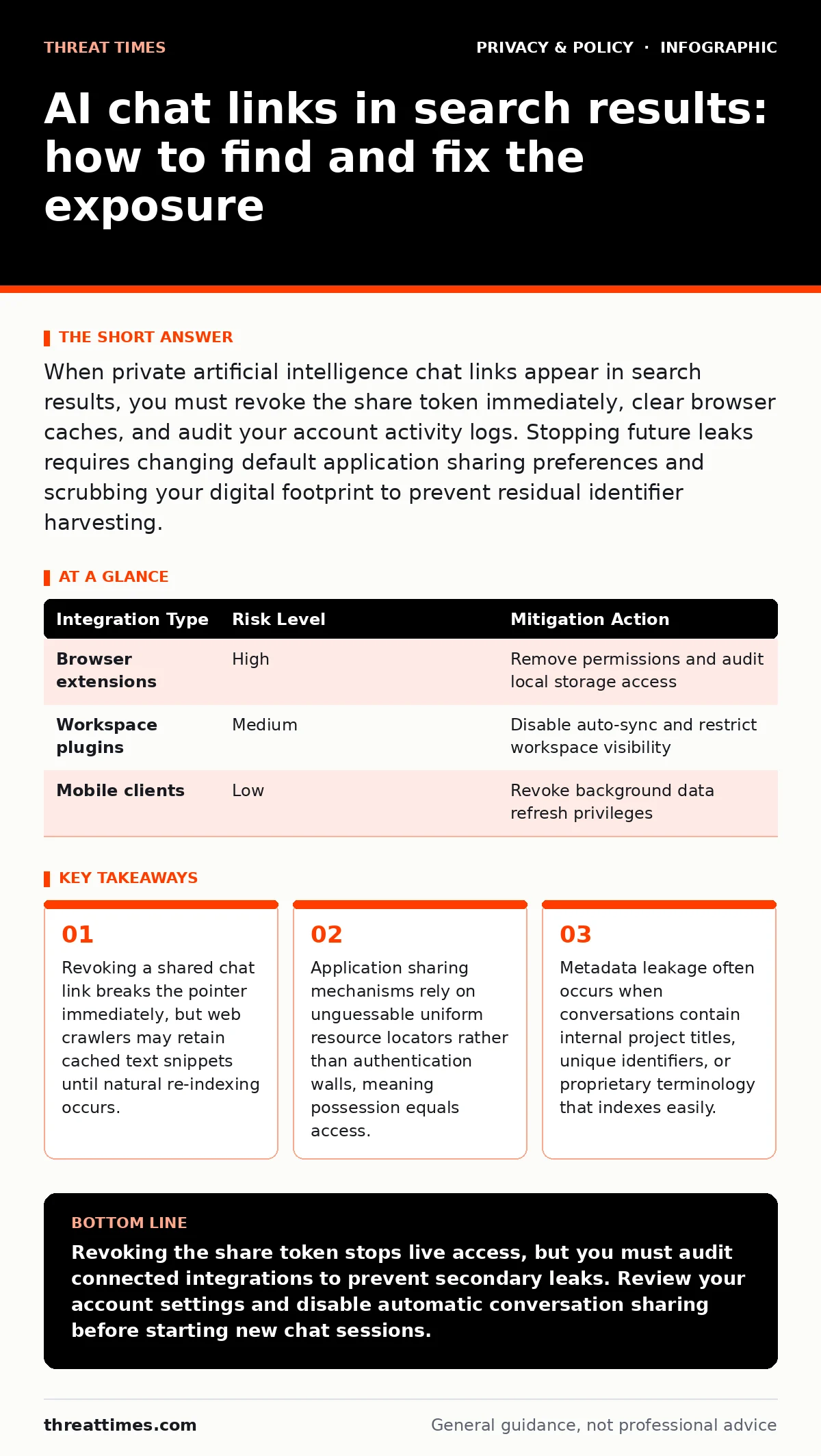
When private artificial intelligence chat links appear in search results, you must revoke the share token immediately, clear browser caches, and audit your account activity logs. Stopping future leaks requires changing default application sharing preferences and scrubbing your digital footprint to prevent residual identifier harvesting.
First hour
Revoking shared chat links immediately stops unauthorized access by invalidating the unique uniform resource locator token generated by the artificial intelligence platform. Shared conversation links bypass traditional authentication walls, functioning instead as public web pages that rely entirely on obscurity for privacy.
- Locate the sharing settings inside the artificial intelligence platform interface and click the revoke or delete button for all active conversation links.
- Check your account session history to verify whether unauthorized IP addresses accessed the exposed chat transcripts during the indexing window.
- Export a local copy of your conversation history before deletion if you need to preserve proprietary work product or personal notes for offline records.
- Clear your local browser cache and search history to remove residual local pointers that might trigger autocomplete suggestions pointing to the exposed URLs.
First day
Auditing connected third-party applications prevents secondary data leakage channels from inadvertently republishing your private queries and generated outputs. Modern productivity tools frequently integrate with artificial intelligence models, automatically synchronizing conversation histories to shared team workspaces or cloud storage repositories without explicit prompting.
| Integration Type | Risk Level | Mitigation Action |
|---|---|---|
| Browser extensions | High | Remove permissions and audit local storage access |
| Workspace plugins | Medium | Disable auto-sync and restrict workspace visibility |
| Mobile clients | Low | Revoke background data refresh privileges |
Reviewing connected application programming interface tokens ensures that external utilities lack ongoing authorization to query your model history or export transcripts. Revocation requires navigating to the security settings menu of the service provider and explicitly terminating active authorization grants for all unverified client software.
First week
Scrubbing residual references across the wider web requires systematic monitoring because search engines cache page content independently of the original source platform. Mentioning a shared chat link in a public forum, code repository, or collaborative document creates secondary indexing paths that persist even after you disable the primary conversation link.
| Platform Type | Indexing Speed | Removal Method |
|---|---|---|
| Code repositories | Instant | Purge commit history and rewrite git branches |
| Public forums | Moderate | Delete user posts and request manual cache flushing |
| Document stores | Slow | Change file sharing permissions to private |
Analyzing your broader digital footprint reveals hidden linkages where personal identifiers or proprietary code snippets might have propagated alongside the chat transcripts. Reducing your digital footprint helps mitigate the risk that automated scrapers correlate your exposed artificial intelligence queries with your real-world identity or corporate affiliation.
Understanding link-based sharing mechanisms
Link-based sharing mechanisms rely on unguessable character strings appended to a base uniform resource locator to grant read-only access to specific conversation threads. Search engine web crawlers discover these links by following accidental outbound references, parsing public social media posts, or ingesting browser telemetry data shared by users.
Web crawlers index these conversation pages because the platform hosting the artificial intelligence model fails to include standard exclusion directives in its hypertext transfer protocol response headers. Without explicit instructions barring automated indexing, search engines treat the shared conversation like any other public web page, displaying snippets of your private prompts in public search results.
Containment and damage assessment
Containment requires identifying every piece of sensitive information transmitted during the exposed session, including internal credentials, personal data, or proprietary source code. Artificial intelligence models frequently retain contextual nuances from previous turns in a conversation, meaning a single shared link can expose multiple distinct topics discussed across a lengthy session.
Assessing the potential fallout involves determining whether malicious actors or automated scrapers harvested the cached text snippets before you revoked the link. Automated scrapers continuously monitor search engine result pages for newly indexed tokens, meaning exposure time directly correlates with the probability of permanent data harvesting.
Preventing future exposure
Preventing future exposure demands altering default application preferences so that new conversations remain strictly private and unshared by default. Many platforms prompt users to share conversations for training or collaboration purposes, introducing friction that can lead to accidental public exposure if you click the wrong interface element.
Adopting disciplined communication habits ensures you never input sensitive credentials, financial data, or trade secrets into third-party artificial intelligence platforms regardless of privacy settings. Treat every cloud-hosted model prompt as publicly accessible data that might eventually surface through unexpected indexing anomalies or platform misconfigurations.
Key takeaways
- Revoking a shared chat link breaks the pointer immediately, but web crawlers may retain cached text snippets until natural re-indexing occurs.
- Application sharing mechanisms rely on unguessable uniform resource locators rather than authentication walls, meaning possession equals access.
- Metadata leakage often occurs when conversations contain internal project titles, unique identifiers, or proprietary terminology that indexes easily.
Revoking the share token stops live access, but you must audit connected integrations to prevent secondary leaks. Review your account settings and disable automatic conversation sharing before starting new chat sessions.
Frequently asked questions
Can search engines still display my chat content after I delete the shared link?
Search engines can display cached text snippets for days or weeks after deletion until their web crawlers revisit the uniform resource locator and detect the resulting error page.
Do artificial intelligence providers index my private chats without explicit sharing?
Reputable platforms do not publish unshared chats to search engines, but telemetry data or third-party browser extensions can inadvertently leak conversation paths.
How do malicious actors find shared chat links before search engines index them?
Automated scripts scan public code repositories, social media platforms, and collaborative document feeds where users frequently paste debugging transcripts and output summaries.
Does clearing my browser history remove the shared chat links from public indexes?
Clearing your local browser history only removes pointers from your device and has no effect on remote search engine indexes or cached web pages.
How this guide was produced: written by the Threat Times editorial team with AI assistance, checked against the public references listed below, and reviewed when the facts change. See our editorial policy or report an error.