Scientists Question AI Weather Forecast Accuracy Amid Historic El Niño Event
The reliability of artificial intelligence in predicting extreme weather is under scrutiny as a major climate pattern tests these new modeling tools.
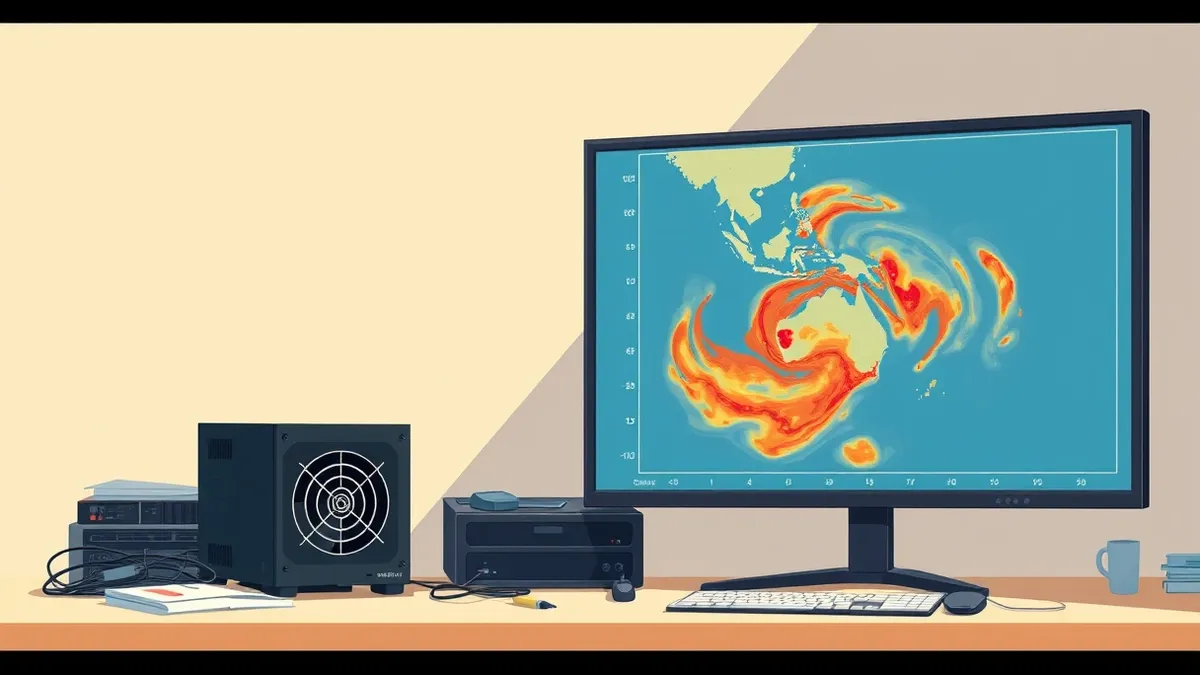
Key points
- Financial Times reports that AI weather forecasting faces a significant accuracy test during the current historic El Niño.
- Some scientists express concern that relying on AI for extreme weather prediction may be a mistake.
- The technology is currently deployed to anticipate forest fires and influence futures contracts.
Artificial intelligence models designed to forecast extreme weather conditions are facing a critical evaluation period in the coming months. This assessment coincides with the development of a historic El Niño climate pattern, which provides a severe stress test for these emerging predictive tools. The Financial Times reports that the accuracy of these AI systems is being closely monitored as they attempt to navigate this complex meteorological event.
The core issue centers on the reliability of machine learning algorithms when confronted with rare or intense climate phenomena. While AI has shown promise in standard forecasting scenarios, the current El Niño represents a deviation from typical baseline conditions. Some scientists question whether these models can maintain their precision under such pressure. The Financial Times notes that this uncertainty has led to professional debate regarding the appropriateness of using AI for high-stakes weather prediction during this period.
Operational Scope and Scientific Skepticism
The applications for these AI forecasting tools extend beyond simple daily weather reports. According to the Financial Times, the technology is being used to anticipate specific extreme events, including the outbreak of forest fires. Additionally, the system influences financial markets by providing data that helps shape futures contracts. This dual use in safety-critical and economic domains amplifies the stakes of any potential model failure.
Despite the broad adoption of these tools, scientific confidence is not universal. The Financial Times highlights that some experts fear the current trajectory of AI deployment in meteorology is a mistake. These scientists argue that the technology may not yet be robust enough to handle the nuances of a historic El Niño without significant risk of error. The debate underscores a tension between rapid technological adoption and the rigorous validation required for accurate climate modeling.
Impact on Forecasting and Markets
The implications of inaccurate AI forecasts are multifaceted, affecting both environmental safety and economic stability. If the models fail to correctly predict the intensity or timing of weather events linked to the El Niño, the consequences could ripple through various sectors. The Financial Times indicates that the technology’s role in anticipating forest fires means that emergency preparedness could be indirectly tied to these algorithmic outputs.
Furthermore, the integration of AI data into financial instruments creates additional exposure. Futures contracts that rely on these weather predictions may be priced based on flawed inputs if the models are inaccurate. While the specific financial impact remains theoretical until the forecasts are tested against reality, the reliance on AI for such contracts suggests that market participants are betting on the technology's continued precision.
What should you do?
Security and technology professionals should monitor how their organizations rely on external AI-driven data feeds for operational planning. As the El Niño progresses, validating AI outputs against traditional meteorological data may become necessary. Teams should review vendor documentation regarding model performance during extreme climate events.
What to do and how to stay safe: Artificial Intelligence
- Verify the provenance of AI-generated weather data used in operational or financial decision-making processes.
- Maintain traditional forecasting methods as a parallel validation source for critical predictions during extreme climate events.
- Review vendor service level agreements to understand liability and accuracy guarantees for AI-based predictive models.
- Monitor official meteorological agency updates for discrepancies between AI forecasts and traditional scientific assessments.
Step-by-step guide: Prompt Injection Warning Signs: How to Spot AI Manipulation
General security guidance from the Threat Times newsroom. It is not confirmed advice from the organisations named in this story.
Frequently asked questions
Why is the current El Niño considered a major test for AI weather forecasting?
The Financial Times reports that the historic nature of the current El Niño challenges the accuracy of AI models that may not be trained on such extreme conditions.
What specific applications of AI weather forecasting are mentioned in the report?
The technology is used to anticipate forest fires and to inform the pricing and trading of futures contracts.
Do scientists support the use of AI for forecasting extreme weather?
Some scientists question the technology's accuracy and fear that relying on it for extreme weather prediction is a mistake, according to the Financial Times.