MITRE ATLAS AI: How to Map Adversarial Tactics for Machine Learning
MITRE ATLAS provides a standardized framework for understanding how attackers manipulate machine learning models, shifting focus from code vulnerabilities to data and algorithmic integrity.
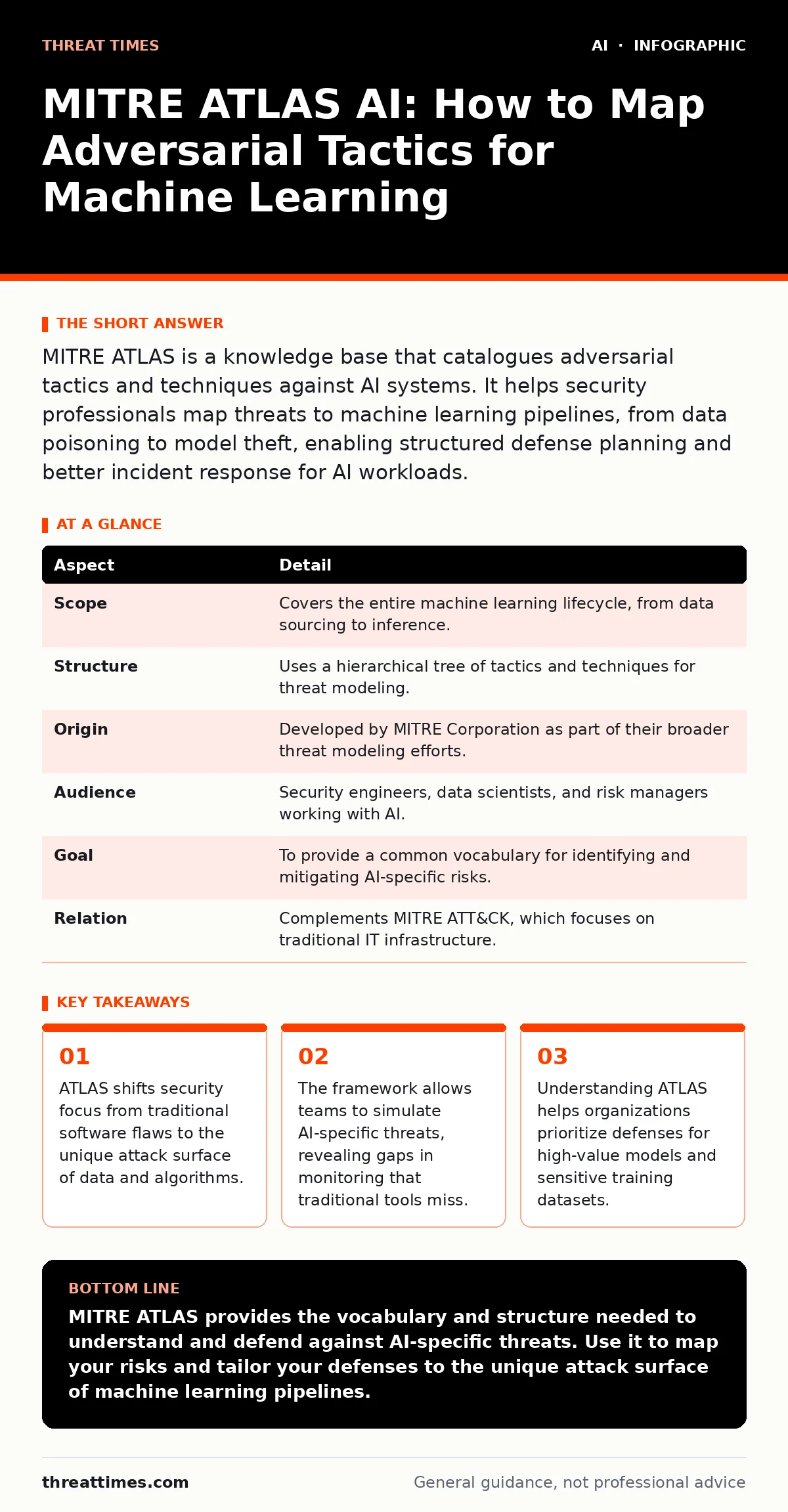
MITRE ATLAS is a knowledge base that catalogues adversarial tactics and techniques against AI systems. It helps security professionals map threats to machine learning pipelines, from data poisoning to model theft, enabling structured defense planning and better incident response for AI workloads.
Imagine you are securing a physical bank. You install locks on the doors and cameras on the walls. Now imagine the bank is a recipe for baking bread. An attacker does not break in to steal cash. Instead, they slip into the flour supply and add a tiny amount of salt that ruins every loaf. Traditional security checks the locks. AI security must check the ingredients.
What is MITRE ATLAS AI
MITRE ATLAS is a publicly available knowledge base that describes the behaviors of adversaries who target artificial intelligence systems. It functions as a map of how attackers interact with machine learning pipelines, from data collection to model deployment. Unlike frameworks that focus on network intrusion, ATLAS focuses on the integrity of the algorithm and its inputs.
The framework categorizes actions into tactics, which are the high-level goals of an attacker, and techniques, which are the specific methods used to achieve those goals. This structure allows security teams to standardize their language when discussing AI risks. You can use it to audit your defenses against known methods of model manipulation.
| Aspect | Detail |
|---|---|
| Scope | Covers the entire machine learning lifecycle, from data sourcing to inference. |
| Structure | Uses a hierarchical tree of tactics and techniques for threat modeling. |
| Origin | Developed by MITRE Corporation as part of their broader threat modeling efforts. |
| Audience | Security engineers, data scientists, and risk managers working with AI. |
| Goal | To provide a common vocabulary for identifying and mitigating AI-specific risks. |
| Relation | Complements MITRE ATT&CK, which focuses on traditional IT infrastructure. |
How ATLAS Works in Practice
The framework operates by breaking down complex attacks into observable behaviors. An attacker might want to degrade a model's accuracy. ATLAS lists the specific ways this can happen, such as injecting malformed data during training or manipulating the features the model relies on. By mapping these behaviors, you can create detection rules that look for anomalies in data distribution rather than just network traffic.
You use ATLAS to perform threat modeling. Start by identifying the assets in your AI pipeline. These include the training data, the model weights, and the inference API. Next, select the tactics from ATLAS that apply to your environment. If you use large language models, you might focus on prompt injection techniques. If you use computer vision, you might focus on adversarial examples that confuse the model with visual noise.
This process reveals gaps in your monitoring. Traditional security tools often treat AI models as black boxes. ATLAS forces you to open the box and understand how the model processes input. This insight is critical for AI security testing, as it ensures tests cover the unique failure modes of machine learning systems, not just standard application bugs.
Who Affected by AI Threats
Any organization that relies on automated decision-making faces risks covered by ATLAS. This includes companies using generative AI for content creation, financial institutions using machine learning for fraud detection, and healthcare providers using models for diagnosis. The impact varies based on the sensitivity of the data and the criticality of the decision.
Suppose a company uses an AI model to approve loan applications. An attacker might use data poisoning to skew the model's understanding of creditworthiness. The model would then approve fraudulent applications or reject legitimate ones. This is not a breach in the traditional sense. No data is stolen. The model's logic is corrupted. The result is financial loss and reputational damage, yet standard intrusion detection systems may show no signs of an attack.
Common Misunderstandings
Many teams assume that securing the server hosting the AI model is sufficient. This is a mistake. The attack surface extends to the data sources and the model architecture. An attacker can compromise a model without ever accessing the server. They can poison the training data from a public source or craft inputs that trigger errors during inference.
Another misconception is that ATLAS replaces traditional security frameworks. It does not. You still need to secure your networks, operating systems, and applications. ATLAS adds a layer of understanding specific to AI. Ignoring this layer leaves you blind to attacks that bypass traditional controls. You must integrate ATLAS with your existing emergency stop for AI systems plans to ensure you can halt a compromised model quickly.
People often confuse model theft with data breaches. AI model theft involves copying the model's weights or architecture to replicate its capabilities. This is distinct from stealing the training data. Both are covered by ATLAS, but they require different defenses. Theft might be detected by unusual API usage patterns, while data poisoning requires statistical analysis of the training set.
Implementing ATLAS Defenses
Start by mapping your AI assets to ATLAS tactics. Identify which techniques are most relevant to your use case. If you use third-party models, focus on supply chain attacks. If you train models in-house, focus on data integrity. This mapping helps you prioritize your testing efforts.
Use ATLAS to design detection mechanisms. For example, if you are concerned about evasion attacks, implement input validation that checks for statistical anomalies. If you are concerned about model extraction, monitor for queries that resemble gradient estimation. These checks add computational overhead but provide necessary visibility into the model's behavior.
Integrate ATLAS into your development lifecycle. Train data scientists on the techniques listed in the framework. This ensures that security considerations are baked into the model design, not added as an afterthought. You can also use ATLAS to communicate risks to stakeholders. A common vocabulary makes it easier to justify investments in AI security testing and monitoring tools.
Beyond ATLAS
ATLAS is a starting point, not a complete solution. It describes what attackers do, not exactly how to stop them. You must combine it with other frameworks and best practices. For example, when building deepfake detection systems, you must consider the techniques ATLAS lists for data poisoning, as attackers can train detectors to miss specific types of forgeries.
The field of AI security is evolving rapidly. New techniques emerge as models become more powerful. ATLAS is updated regularly to reflect these changes. You should subscribe to updates and review your threat model periodically. The goal is to stay ahead of adversaries who are also using AI to improve their attacks.
Remember that no framework provides complete protection. ATLAS helps you understand the battlefield. It does not fight the war for you. You must implement robust controls, monitor continuously, and respond swiftly to incidents. The complexity of AI systems requires a nuanced approach to security that goes beyond traditional IT practices.
Key takeaways
- ATLAS shifts security focus from traditional software flaws to the unique attack surface of data and algorithms.
- The framework allows teams to simulate AI-specific threats, revealing gaps in monitoring that traditional tools miss.
- Understanding ATLAS helps organizations prioritize defenses for high-value models and sensitive training datasets.
MITRE ATLAS provides the vocabulary and structure needed to understand and defend against AI-specific threats. Use it to map your risks and tailor your defenses to the unique attack surface of machine learning pipelines.
Frequently asked questions
Is MITRE ATLAS free to use?
Yes, MITRE ATLAS is a publicly available resource that organizations can access and use without licensing fees to improve their AI security posture.
Does ATLAS cover generative AI risks?
Yes, ATLAS includes tactics and techniques relevant to generative AI, such as prompt injection and data leakage through model outputs.
How often is ATLAS updated?
The framework is updated regularly by the MITRE team to include new tactics, techniques, and procedures as the AI threat environment evolves.
Can ATLAS be used for compliance?
While ATLAS is not a regulatory standard, it can support compliance efforts by demonstrating a structured approach to AI risk management and threat modeling.
How this guide was produced: written by the Threat Times editorial team with AI assistance, checked against the public references listed below, and reviewed when the facts change. See our editorial policy or report an error.