OAuth Misconfigurations: 9 Critical Questions Answered
Default scopes and overly permissive redirect URIs expose user data long before an attacker exploits a server-side vulnerability.

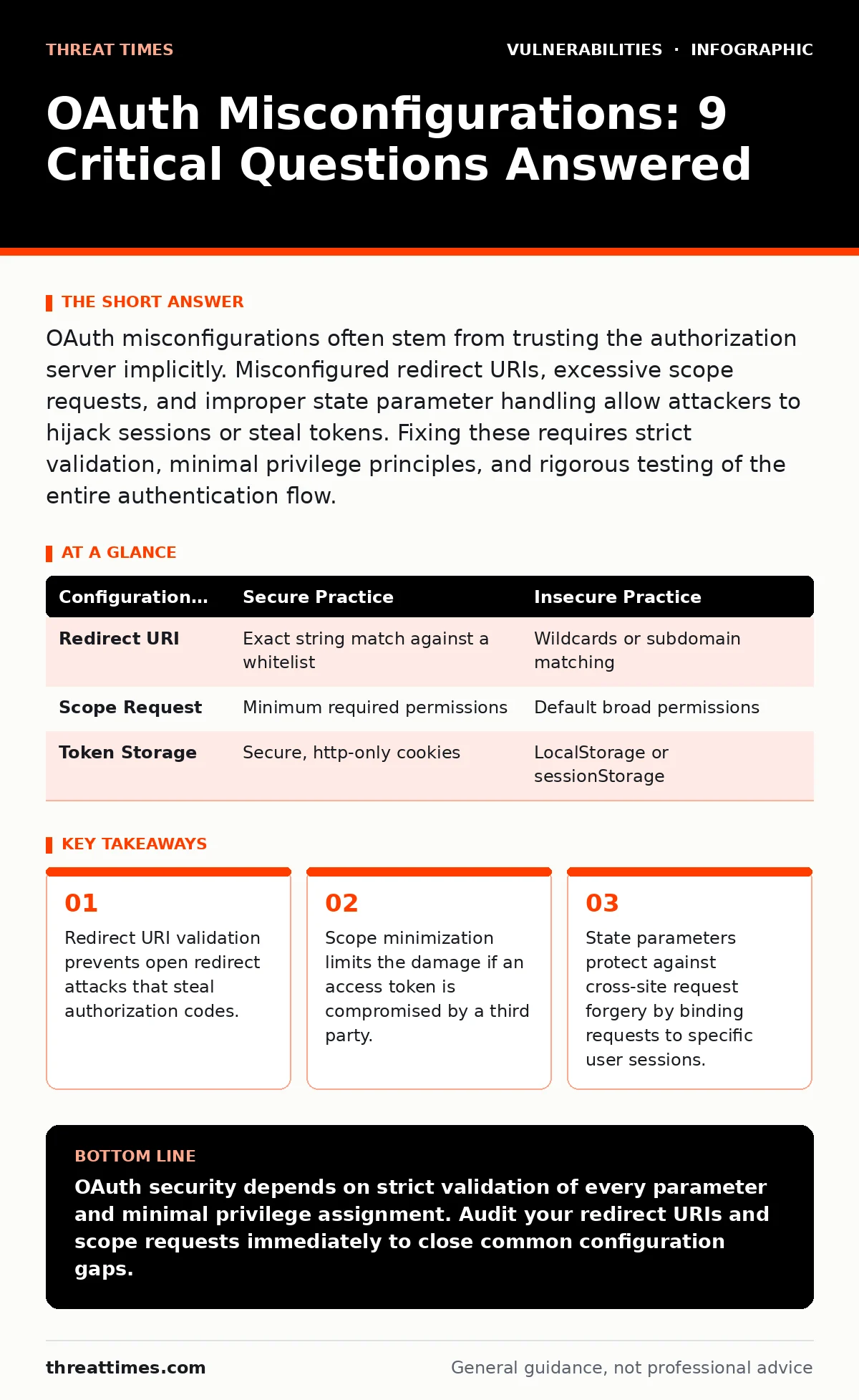
OAuth misconfigurations often stem from trusting the authorization server implicitly. Misconfigured redirect URIs, excessive scope requests, and improper state parameter handling allow attackers to hijack sessions or steal tokens. Fixing these requires strict validation, minimal privilege principles, and rigorous testing of the entire authentication flow.
What is the primary risk of OAuth misconfiguration?
OAuth misconfigurations primarily risk unauthorized access to user data and account takeover. The protocol delegates authentication to a trusted provider, but the relying party controls how tokens are used. If the implementation fails to validate inputs or restrict permissions, attackers can intercept tokens or force users to grant excessive access. This breaks the trust boundary between the service provider and the client application.
Why do redirect URIs create a security gap?
Redirect URIs create a security gap when the authorization server does not strictly validate the destination. An attacker can register a malicious domain that mimics a legitimate service. When the user authenticates, the authorization code is sent to the attacker’s server instead of the intended application. This allows the attacker to exchange the code for an access token and impersonate the user.
| Configuration Aspect | Secure Practice | Insecure Practice |
|---|---|---|
| Redirect URI | Exact string match against a whitelist | Wildcards or subdomain matching |
| Scope Request | Minimum required permissions | Default broad permissions |
| Token Storage | Secure, http-only cookies | LocalStorage or sessionStorage |
How does scope creep increase attack surface?
Scope creep increases the attack surface by granting applications more permissions than necessary. When an application requests "read" and "write" access but only needs "read," a compromised token allows data modification. This violates the principle of least privilege. Attackers exploit this by targeting applications with high-privilege tokens, using them to alter settings or exfiltrate sensitive data beyond the original intent.
What role does the state parameter play in security?
The state parameter binds the authentication request to the user’s session to prevent cross-site request forgery. It is a random value generated by the client and sent to the authorization server. Upon redirection, the client verifies that the returned state matches the original. Without this check, an attacker can trick a user into initiating an authentication flow that grants access to the attacker’s account, effectively hijacking the session.
Why is storing tokens in LocalStorage dangerous?
Storing tokens in LocalStorage is dangerous because it exposes them to cross-site scripting attacks. JavaScript code running on the page can read LocalStorage contents. If an attacker injects malicious script into the application, they can steal the access token immediately. Secure implementations store tokens in http-only cookies, which are not accessible via JavaScript, thereby mitigating the risk of token theft through script injection.
See also: Router Firmware Vulnerabilities: Risks and Protection for Small Businesses · Detect CI/CD Pipeline Vulnerabilities: Signals, Blind Spots and Tools
How do implicit flows differ from authorization code flows?
Implicit flows differ from authorization code flows by returning tokens directly in the URL fragment. This exposes the token to browser history, server logs, and referer headers. The authorization code flow returns a short-lived code that the server exchanges for a token securely. This server-side exchange keeps the token out of the client-side environment, significantly reducing the window of opportunity for interception.
What happens when PKCE is omitted in public clients?
Omitting PKCE in public clients allows authorization code interception attacks. Public clients, such as mobile or single-page applications, cannot securely store a client secret. PKCE adds a verifier code to the request, ensuring that only the client that initiated the request can exchange the code for a token. Without PKCE, an attacker who intercepts the authorization code can redeem it, bypassing the need for a client secret.
How do refresh tokens impact long-term security?
Refresh tokens impact long-term security by providing persistent access without requiring re-authentication. If a refresh token is stolen, an attacker can maintain access indefinitely, even if the initial access token expires. This makes refresh tokens high-value targets. Implementing rotation, where a new refresh token is issued with each use, and invalidating old tokens, limits the damage of a compromised token.
What is the impact of overly permissive CORS policies?
Overly permissive CORS policies allow unauthorized domains to read API responses. When an OAuth-protected API allows any origin to access its data, an attacker can create a malicious website that fetches sensitive information from the user’s session. This bypasses same-origin policy protections. Restricting CORS to known, trusted origins ensures that only legitimate applications can interact with the API on behalf of the user.
How does token introspection help in monitoring?
Token introspection helps in monitoring by allowing servers to check the validity and scope of a token in real time. When a resource server receives a token, it can query the authorization server to verify its status. This is particularly useful for distributed systems where multiple services need to validate tokens. It enables immediate revocation of compromised tokens and provides visibility into how tokens are being used across the infrastructure.
What is the hidden cost of implementing OAuth correctly?
The hidden cost of implementing OAuth correctly is the operational overhead of managing secrets and rotating credentials. Applications must securely store client secrets and handle rotation without disrupting service. This requires automated processes and robust secret management systems. Failure to manage these secrets leads to exposure, while overly complex management introduces operational friction and potential misconfigurations.
How do misconfigurations relate to insecure deserialization?
Misconfigurations can relate to insecure deserialization when OAuth tokens or user profiles are serialized and stored improperly. If the application deserializes untrusted data without validation, attackers can inject malicious objects. This can lead to remote code execution. Ensuring that serialized data is authenticated and integrity-checked prevents attackers from manipulating the state of the application through crafted tokens.
What is the connection between OAuth and output encoding?
The connection between OAuth and output encoding lies in how token values are displayed or logged. If access tokens are output to HTML without proper encoding, they can be exploited via cross-site scripting. Attackers can inject scripts that steal these tokens. Proper output encoding ensures that token values are treated as data, not executable code, protecting them from being hijacked through reflected injection vulnerabilities.
How does attack surface management apply to OAuth?
Attack surface management applies to OAuth by identifying and reducing the number of endpoints and parameters exposed to users. Every redirect URI, scope, and parameter is a potential entry point for attackers. Regularly auditing these configurations and removing unused integrations reduces the opportunities for exploitation. This proactive approach minimizes the risk of misconfigurations going undetected in complex environments.
Key takeaways
- Redirect URI validation prevents open redirect attacks that steal authorization codes.
- Scope minimization limits the damage if an access token is compromised by a third party.
- State parameters protect against cross-site request forgery by binding requests to specific user sessions.
OAuth security depends on strict validation of every parameter and minimal privilege assignment. Audit your redirect URIs and scope requests immediately to close common configuration gaps.
Frequently asked questions
Can OAuth be used for internal microservices?
OAuth is generally overkill for internal microservices; use mutual TLS or short-lived JWTs for internal service-to-service authentication to reduce complexity.
What is the difference between access and refresh tokens?
Access tokens grant immediate access to resources and are short-lived, while refresh tokens are used to obtain new access tokens without user interaction and are long-lived.
How do I detect an OAuth token leak?
Monitor for unusual API activity, such as access from new IP addresses or devices, and implement token introspection to check for active sessions unexpectedly.
Is OAuth 2.0 secure by default?
No, OAuth 2.0 is secure by design but insecure by default; proper implementation requires strict adherence to security best practices and careful configuration.
How this guide was produced: written by the Threat Times editorial team with AI assistance, checked against the public references listed below, and reviewed when the facts change. See our editorial policy or report an error.