CVE Monitoring for Small Teams: Practical Strategies
Automated scanning often misses context, requiring manual validation to distinguish critical risks from noisy false positives that waste limited resources.

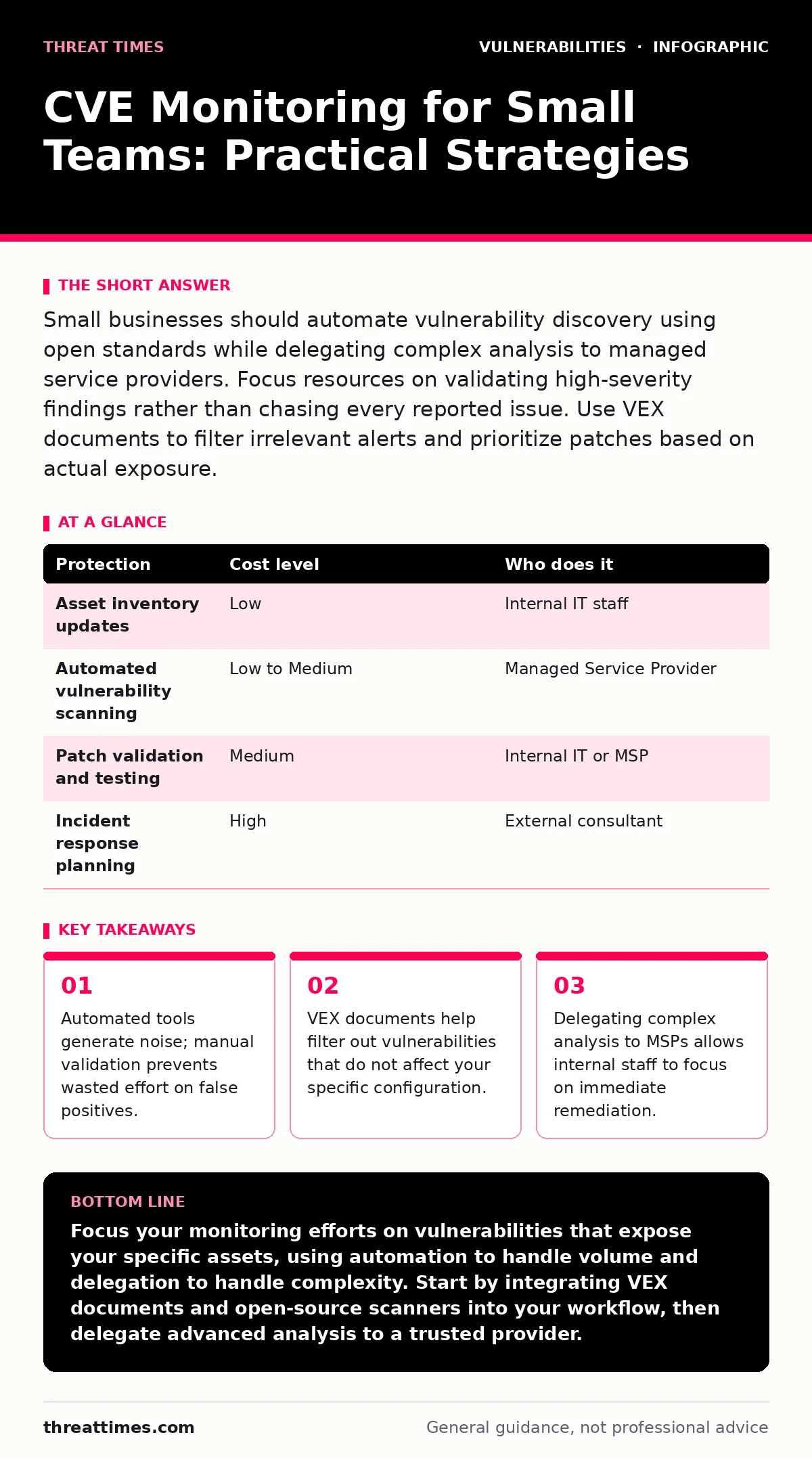
Small businesses should automate vulnerability discovery using open standards while delegating complex analysis to managed service providers. Focus resources on validating high-severity findings rather than chasing every reported issue. Use VEX documents to filter irrelevant alerts and prioritize patches based on actual exposure.
Why Small Scale Changes the Monitoring Equation
Small organizations face a unique constraint in vulnerability management. Large enterprises have teams dedicated to triaging alerts, but small teams have limited bandwidth. You cannot monitor every Common Vulnerability and Exposure identifier manually. The volume of new disclosures exceeds human capacity. Automation becomes necessary, but automation without context creates noise.
The primary goal is not to find every flaw. The goal is to find the flaws that expose your specific assets. A vulnerability in a library you do not use is irrelevant. A flaw in an exposed web server is critical. You must filter the signal from the noise.
The Hidden Cost of Unfiltered Alerts
Alert fatigue is a real risk for small teams. When every minor issue triggers an urgent notification, staff begin to ignore warnings. This desensitization allows critical threats to slip through. You need a system that prioritizes based on exposure, not just severity scores.
Consider the difference between a theoretical flaw and an exploitable condition. Many published vulnerabilities require specific conditions to trigger. If your configuration does not meet those conditions, the risk is low. Monitoring tools that do not account for configuration details will overreport risk. This leads to wasted time patching systems that were never at risk.
Affordable Ways to Implement Monitoring
You do not need expensive commercial platforms to start monitoring. Open standards and public frameworks provide reliable data sources. The National Vulnerability Database publishes structured data that tools can consume. Many open-source scanners can query this data and report findings.
Integrate these tools into your existing workflow. Connect scanners to your ticketing system. This ensures that findings are tracked and assigned. Use scripts to automate the initial scan. Reserve human time for reviewing the results. This hybrid approach balances cost with effectiveness.
| Protection | Cost level | Who does it |
|---|---|---|
| Asset inventory updates | Low | Internal IT staff |
| Automated vulnerability scanning | Low to Medium | Managed Service Provider |
| Patch validation and testing | Medium | Internal IT or MSP |
| Incident response planning | High | External consultant |
What to Delegate to Experts
Not every task requires internal expertise. Small teams should delegate complex analysis to managed service providers. These providers have access to specialized tools and experienced analysts. They can interpret complex technical details and provide actionable recommendations.
Delegating scanning and initial triage frees your internal staff. They can focus on applying patches and maintaining systems. This division of labor ensures that critical tasks are handled by the right people. Ensure your provider uses industry-standard methodologies. Ask for clear reporting that explains the risk in business terms.
Filtering Noise with VEX Documents
Vulnerability Exploitability eXchange (VEX) documents help filter irrelevant alerts. These documents state whether a specific product or configuration is affected by a known vulnerability. They provide context that automated scanners often miss.
Integrate VEX data into your monitoring process. This reduces the number of false positives you need to review. It allows you to focus on vulnerabilities that actually impact your environment. Not all vendors provide VEX documents, but those that do offer significant value. Look for providers that support this standard.
See also: Risk-Based Vulnerability Management: Prioritize Fixes by Actual Danger
Questions to Ask Your IT Provider
When selecting a provider for vulnerability management, ask specific questions. Their answers will reveal their capability and approach. Do not rely on generic marketing claims. Seek concrete details about their process.
- How do you prioritize vulnerabilities based on our specific environment?
- Do you use VEX documents to reduce false positives?
- What is your process for validating critical findings before alerting us?
- How do you handle vulnerabilities in third-party components like npm packages?
- Can you provide examples of how you have helped similar clients reduce risk?
Integrating Monitoring into Daily Operations
Vulnerability monitoring is not a one-time task. It is an ongoing process. Integrate it into your daily operations. Schedule regular scans and reviews. Ensure that new assets are added to your inventory immediately.
Automate the scanning process where possible. Use scripts to trigger scans after changes to your infrastructure. This ensures that new vulnerabilities are detected quickly. Combine this with manual reviews for critical systems. This layered approach provides better coverage.
Beyond Basic Patching
Patching is not the only response to a vulnerability. Sometimes, a patch is not available. In these cases, you must use compensating controls. These controls reduce the risk without fixing the underlying flaw.
Examples include network segmentation, access controls, and runtime protection. These measures limit the impact of a potential exploit. They buy time until a patch is available. Evaluate each vulnerability to determine the best response. Not every issue requires an immediate patch.
Maintaining a Sustainable Process
Sustainability is key for small teams. Overcomplicating your process leads to burnout. Keep your monitoring strategy simple and focused. Review and refine it regularly.
Ensure that your team understands the process. Provide training on how to interpret reports and apply patches. Encourage a culture of security awareness. This helps prevent vulnerabilities from being introduced in the first place. Regular reviews help you adapt to changing threats and technologies.
Key takeaways
- Automated tools generate noise; manual validation prevents wasted effort on false positives.
- VEX documents help filter out vulnerabilities that do not affect your specific configuration.
- Delegating complex analysis to MSPs allows internal staff to focus on immediate remediation.
Focus your monitoring efforts on vulnerabilities that expose your specific assets, using automation to handle volume and delegation to handle complexity. Start by integrating VEX documents and open-source scanners into your workflow, then delegate advanced analysis to a trusted provider.
Frequently asked questions
How often should we run vulnerability scans?
Run scans at least weekly for internet-facing assets. Internal assets can be scanned monthly, but increase frequency after significant changes or new deployments.
Do we need to monitor npm packages separately?
Yes, dependencies like npm packages often have their own supply chain risks. Use specialized tools that analyze your project’s dependency tree for known vulnerabilities.
What if a patch is not available?
Implement compensating controls such as network segmentation or strict access controls. Monitor for exploit activity and apply the patch as soon as it becomes available.
How do we handle coordinated vulnerability disclosure?
Follow established protocols for receiving and handling reports. Ensure you have a process to validate and respond to disclosures within a reasonable timeframe.
How this guide was produced: written by the Threat Times editorial team with AI assistance, checked against the public references listed below, and reviewed when the facts change. See our editorial policy or report an error.