VEX Documents: How to Manage Vulnerability Exceptions in Software
VEX documents transform raw vulnerability data into actionable business decisions by proving why a specific flaw does not impact your deployment.

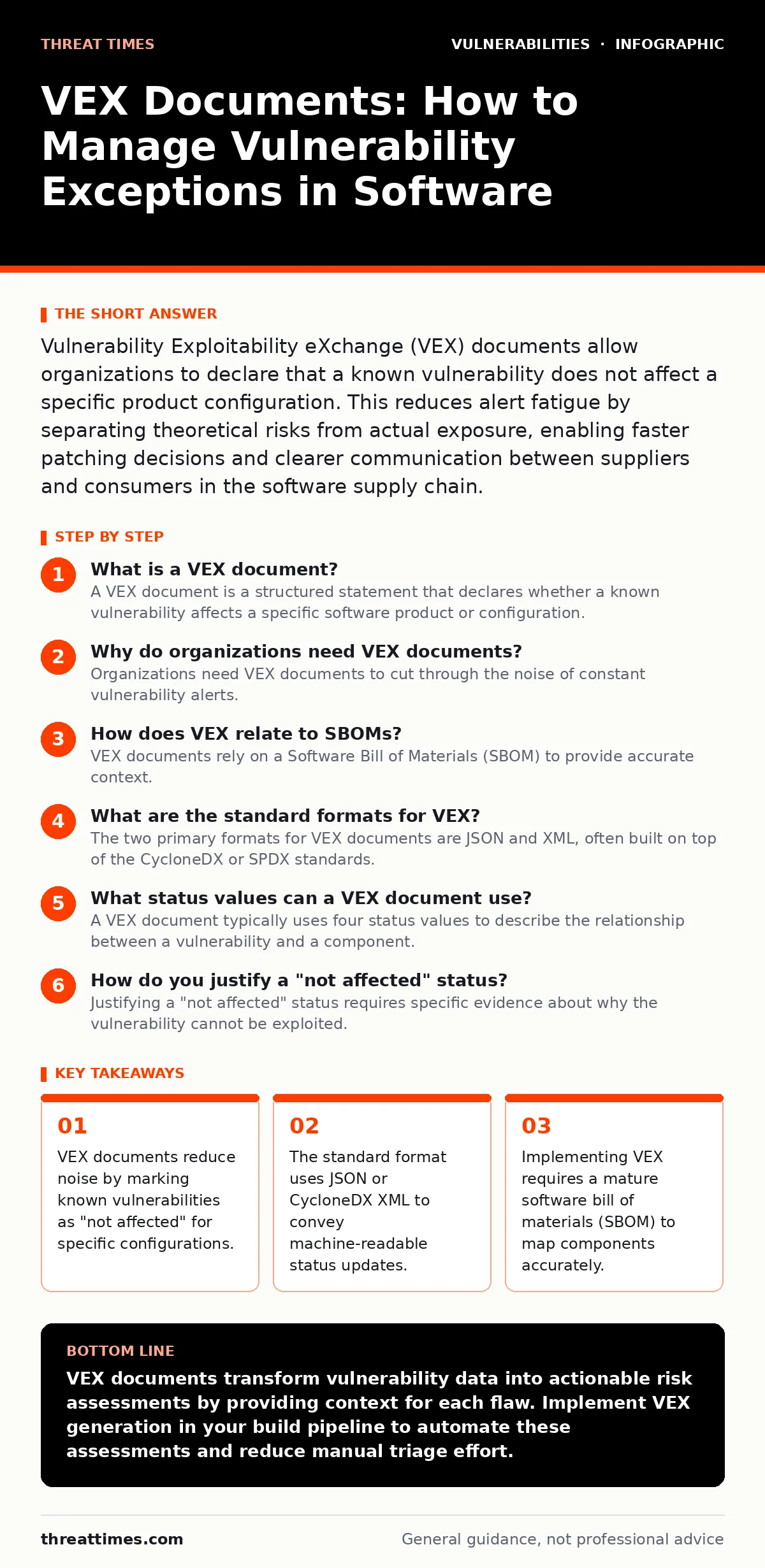
Vulnerability Exploitability eXchange (VEX) documents allow organizations to declare that a known vulnerability does not affect a specific product configuration. This reduces alert fatigue by separating theoretical risks from actual exposure, enabling faster patching decisions and clearer communication between suppliers and consumers in the software supply chain.
What is a VEX document?
A VEX document is a structured statement that declares whether a known vulnerability affects a specific software product or configuration. It moves beyond the raw data of a vulnerability database by providing context about the specific deployment. This context allows security teams to distinguish between a theoretical flaw in a library and an actual risk to their running systems. The document links a Common Vulnerabilities and Exposures (CVE) identifier to a specific component version and states its exploitability status.
Why do organizations need VEX documents?
Organizations need VEX documents to cut through the noise of constant vulnerability alerts. Security teams often face hundreds of warnings for libraries that are present in code but never executed or exposed. Without a VEX statement, every alert requires manual triage to determine if the flaw is reachable. VEX documents automate this triage by providing a supplier’s or operator’s assessment. This reduces the time spent investigating false positives and focuses remediation efforts on genuine risks.
How does VEX relate to SBOMs?
VEX documents rely on a Software Bill of Materials (SBOM) to provide accurate context. An SBOM lists every component and dependency in a software product, creating the inventory that VEX evaluates. You cannot declare a vulnerability "not affected" if you do not know which components are present. The VEX document references specific items from the SBOM, linking them to vulnerability identifiers. This relationship ensures that the assessment applies to the exact version of the software in question.
What are the standard formats for VEX?
The two primary formats for VEX documents are JSON and XML, often built on top of the CycloneDX or SPDX standards. CycloneDX provides a specific VEX module that integrates with its SBOM structure. SPDX offers a similar capability through its vulnerability fields. These formats allow machines to parse the data automatically. They include fields for the vulnerability ID, the affected component, the status, and a justification. Using a standard format ensures interoperability between different security tools and platforms.
| Format | Structure | Primary Use Case | Integration |
|---|---|---|---|
| CycloneDX VEX | JSON or XML | Detailed component analysis | Native SBOM extension |
| SPDX VEX | JSON or XML | License and vulnerability tracking | Standard SBOM fields |
| Custom CSV | Text | Simple reporting | Manual processing |
What status values can a VEX document use?
A VEX document typically uses four status values to describe the relationship between a vulnerability and a component. "Not affected" means the flaw cannot be exploited in this configuration. "Affected" means the vulnerability is present and exploitable. "Fixed" indicates that a newer version of the component resolves the issue. "Under investigation" means the status is currently unknown. These values allow consumers to filter alerts based on the severity of the actual risk rather than the theoretical severity of the CVE.
See also: Risk Based Vulnerability Management: Prioritize Fixes by Actual Threat
How do you justify a "not affected" status?
Justifying a "not affected" status requires specific evidence about why the vulnerability cannot be exploited. Common justifications include the absence of the vulnerable code path, the presence of mitigating controls, or the lack of required input conditions. For example, a library may contain a flaw, but the application only uses safe functions that never trigger the bug. Documenting this reasoning is critical for trust. Without justification, consumers cannot verify the claim and may treat the vulnerability as active.
What are the challenges of implementing VEX?
Implementing VEX at scale presents significant operational challenges. The primary difficulty is maintaining accuracy as software changes rapidly. Every code commit or dependency update may change the exploitability status of known vulnerabilities. Teams must integrate VEX generation into their CI/CD pipeline vulnerabilities workflow to ensure updates are automatic. Manual creation of VEX documents is unsustainable for large projects. Another challenge is the lack of standardized tooling for generating and validating these documents across different ecosystems.
How does VEX impact vendor relationships?
VEX documents shift the burden of vulnerability assessment from the consumer to the producer. Suppliers must provide accurate VEX statements for their products to be trusted by downstream users. This creates a new expectation in software procurement. Buyers can request VEX data as part of their security requirements. It also facilitates better communication about risk. Instead of vague assurances, suppliers provide concrete data about which vulnerabilities are relevant. This transparency helps both parties manage security more effectively.
Can VEX replace CVE monitoring?
VEX documents do not replace CVE monitoring; they complement it. CVE monitoring identifies new vulnerabilities in the ecosystem. VEX documents apply those findings to specific products. You still need to track new CVEs to know what to assess. VEX helps you decide which of those new CVEs require action. Think of CVE monitoring as the radar and VEX as the filter. Without the radar, you miss new threats. Without the filter, you drown in irrelevant alerts. Both are necessary for effective security management.
How does VEX help with memory corruption bugs?
Memory corruption bugs are often difficult to assess without deep code analysis. VEX documents help by declaring whether a specific memory safety issue is reachable in a given build. For instance, a library may have a buffer overflow, but the application may use memory-safe wrappers that prevent exploitation. The VEX document captures this nuance. It allows security teams to skip remediation for flaws that are theoretically present but practically inert. This is particularly useful for legacy codebases where patching is difficult.
Key takeaways
- VEX documents reduce noise by marking known vulnerabilities as "not affected" for specific configurations.
- The standard format uses JSON or CycloneDX XML to convey machine-readable status updates.
- Implementing VEX requires a mature software bill of materials (SBOM) to map components accurately.
VEX documents transform vulnerability data into actionable risk assessments by providing context for each flaw. Implement VEX generation in your build pipeline to automate these assessments and reduce manual triage effort.
Frequently asked questions
Does VEX replace the need for patching software?
No, VEX documents help prioritize patching by identifying which vulnerabilities actually affect your systems. You still need to patch flaws that are marked as "affected" or "fixed" in newer versions.
Can I create VEX documents manually?
Yes, but manual creation is error-prone and does not scale. Automated generation through CI/CD pipelines is recommended for accuracy and consistency across large software projects.
Who is responsible for creating VEX documents?
Software producers are ideally responsible for creating VEX documents for their products. However, consumers can also create VEX documents for their specific deployments if supplier data is unavailable.
How often should VEX documents be updated?
VEX documents should be updated with every software release or significant configuration change. This ensures that the exploitability status remains accurate and reflects the current state of the product.
How this guide was produced: written by the Threat Times editorial team with AI assistance, checked against the public references listed below, and reviewed when the facts change. See our editorial policy or report an error.