Ivanti VPN Vulnerabilities Prevention Checklist for Secure Access
Network segmentation and strict certificate validation prevent lateral movement when remote access appliances suffer from unpatched memory corruption bugs.

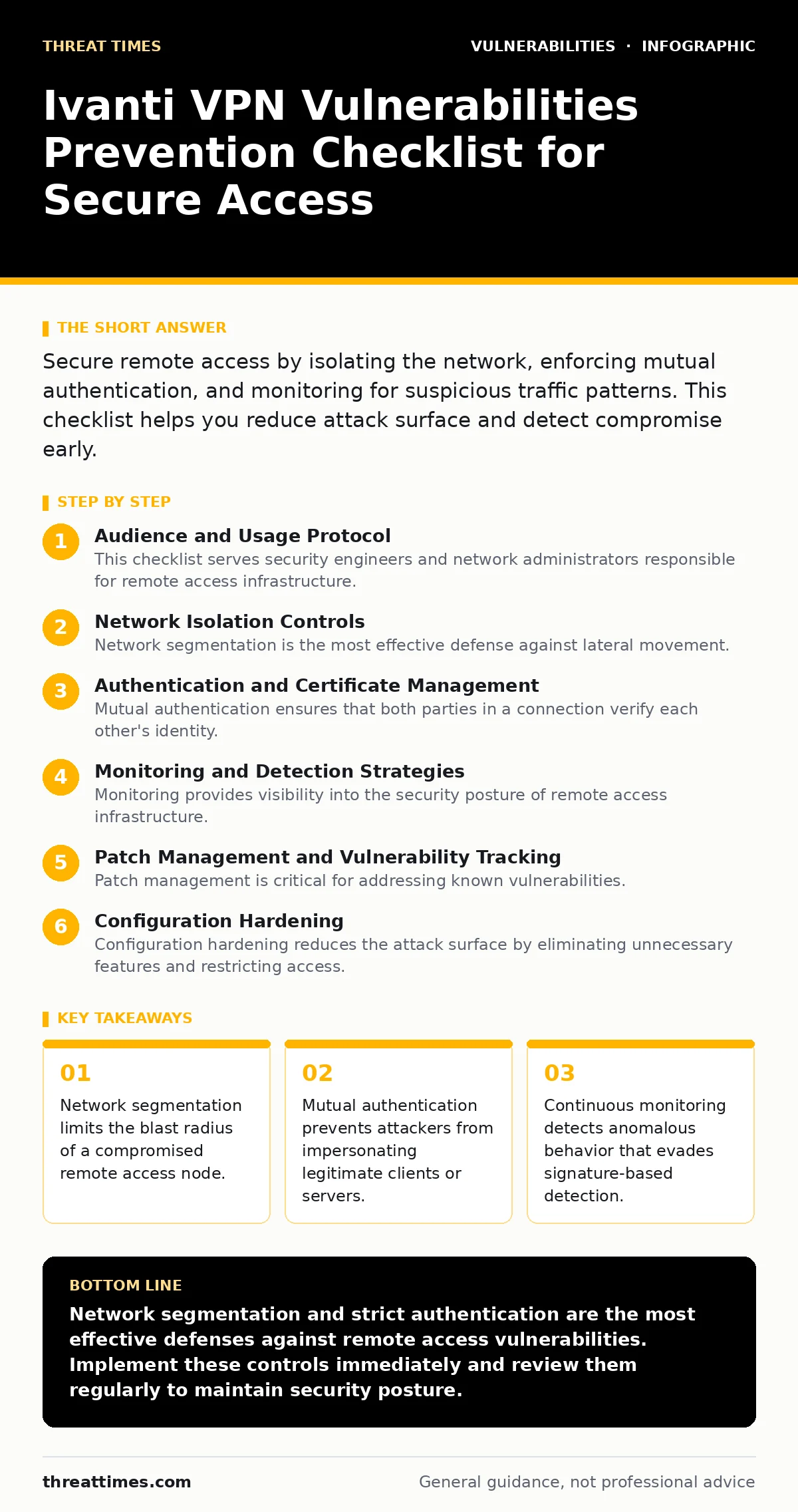
Secure remote access by isolating the network, enforcing mutual authentication, and monitoring for suspicious traffic patterns. This checklist helps you reduce attack surface and detect compromise early.
Audience and Usage Protocol
This checklist serves security engineers and network administrators responsible for remote access infrastructure. You use this list to verify defensive posture against known vulnerabilities in virtual private network appliances. Each item addresses a specific control that mitigates risk when patches are unavailable or delayed. Review these controls quarterly and after major configuration changes.
Network Isolation Controls
- Segment remote access appliances from internal networks: isolation prevents lateral movement if the device is compromised.
- Restrict inbound traffic to known IP ranges: limiting source addresses reduces exposure to automated scanning tools.
- Implement egress filtering for remote connections: controlling outbound traffic prevents data exfiltration through the tunnel.
- Disable unused services on remote access nodes: reducing attack surface eliminates unnecessary entry points for attackers.
- Use jump hosts for administrative access: indirect access adds an additional layer of authentication and logging.
Network segmentation is the most effective defense against lateral movement. When an attacker compromises a remote access appliance, they gain access to the network segment it resides in. Proper segmentation ensures that sensitive resources remain inaccessible from that segment. This control is particularly important when dealing with memory corruption bugs that allow arbitrary code execution.
Authentication and Certificate Management
- Enforce mutual TLS authentication: both client and server verify identities, preventing man-in-the-middle attacks.
- Disable legacy authentication protocols: older protocols often lack modern security features and are vulnerable to exploitation.
- Implement certificate pinning: binding clients to specific certificates prevents attackers from using fraudulent certificates.
- Regularly rotate authentication certificates: frequent rotation limits the window of opportunity for stolen certificates.
- Disable anonymous authentication methods: requiring explicit credentials prevents unauthorized access through default configurations.
Mutual authentication ensures that both parties in a connection verify each other's identity. This prevents attackers from impersonating legitimate clients or servers. Certificate pinning adds an additional layer of security by binding clients to specific certificates. This prevents attackers from using fraudulent certificates issued by compromised certificate authorities.
Monitoring and Detection Strategies
- Enable detailed logging on remote access appliances: comprehensive logs provide visibility into connection attempts and user activity.
- Monitor for unusual authentication patterns: detecting multiple failed attempts or logins from unexpected locations helps identify attacks.
- Implement network traffic analysis: analyzing traffic patterns helps detect anomalies that may indicate compromise.
- Set up alerts for configuration changes: immediate notification of changes helps detect unauthorized modifications.
- Review logs regularly for suspicious activity: consistent review ensures that potential threats are identified and addressed promptly.
Monitoring provides visibility into the security posture of remote access infrastructure. Detailed logging captures information about connection attempts, user activity, and configuration changes. Analyzing this data helps identify patterns that may indicate compromise. Network traffic analysis can detect anomalies that evade signature-based detection.
Patch Management and Vulnerability Tracking
- Subscribe to vendor security advisories: timely notification of vulnerabilities ensures that patches are applied promptly.
- Test patches in a staging environment: testing ensures that patches do not introduce new issues or break existing functionality.
- Maintain an inventory of remote access appliances: knowing what devices are in use helps ensure that all devices are patched.
- Implement automated patch deployment: automation reduces the time between vulnerability disclosure and patch application.
- Track CVE monitoring for relevant components: staying informed about vulnerabilities in underlying components helps prioritize patching efforts.
Patch management is critical for addressing known vulnerabilities. Subscribing to vendor security advisories ensures that you are notified of new vulnerabilities as soon as they are disclosed. Testing patches in a staging environment ensures that they do not introduce new issues. Automated patch deployment reduces the time between vulnerability disclosure and patch application.
Configuration Hardening
- Disable default accounts: removing default accounts prevents attackers from using known credentials to gain access.
- Enforce strong password policies: requiring complex passwords makes it harder for attackers to guess credentials.
- Limit administrative access to specific IP ranges: restricting access reduces the risk of unauthorized administrative changes.
- Disable unnecessary features: reducing functionality minimizes the attack surface and potential entry points.
- Regularly review and update configurations: consistent review ensures that configurations remain secure and up-to-date.
Configuration hardening reduces the attack surface by eliminating unnecessary features and restricting access. Disabling default accounts prevents attackers from using known credentials. Enforcing strong password policies makes it harder for attackers to guess credentials. Limiting administrative access to specific IP ranges reduces the risk of unauthorized changes.
Incident Response Preparation
- Develop an incident response plan for remote access compromises: a clear plan ensures that teams know how to respond to incidents.
- Conduct regular incident response drills: practicing response procedures helps teams identify gaps and improve readiness.
- Maintain backup configurations: backups allow for quick restoration of secure configurations if compromised.
- Document recovery procedures: clear documentation ensures that recovery efforts are efficient and effective.
- Review and update incident response plans regularly: consistent review ensures that plans remain relevant and effective.
Incident response preparation ensures that teams are ready to respond to compromises. Developing a clear plan ensures that teams know how to respond to incidents. Conducting regular drills helps teams identify gaps and improve readiness. Maintaining backup configurations allows for quick restoration of secure configurations if compromised.
Key takeaways
- Network segmentation limits the blast radius of a compromised remote access node.
- Mutual authentication prevents attackers from impersonating legitimate clients or servers.
- Continuous monitoring detects anomalous behavior that evades signature-based detection.
Network segmentation and strict authentication are the most effective defenses against remote access vulnerabilities. Implement these controls immediately and review them regularly to maintain security posture.
Frequently asked questions
How often should I review my remote access security configuration?
Review your configuration quarterly and after any major changes to ensure that security controls remain effective.
What is the most critical vulnerability in remote access appliances?
Memory corruption bugs that allow arbitrary code execution are the most critical, as they can lead to complete compromise.
How do I detect a compromised remote access appliance?
Monitor for unusual authentication patterns, network traffic anomalies, and unauthorized configuration changes.
What should I do if I discover a vulnerability in my remote access software?
Apply patches immediately, isolate the affected system, and review logs for signs of compromise.
How this guide was produced: written by the Threat Times editorial team with AI assistance, checked against the public references listed below, and reviewed when the facts change. See our editorial policy or report an error.