Fast Flux DNS: How Attackers Hide Infrastructure and How to Detect It
Fast flux DNS obscures malicious infrastructure by rotating IP addresses rapidly, making traditional blocking ineffective and requiring behavioral analysis for detection.

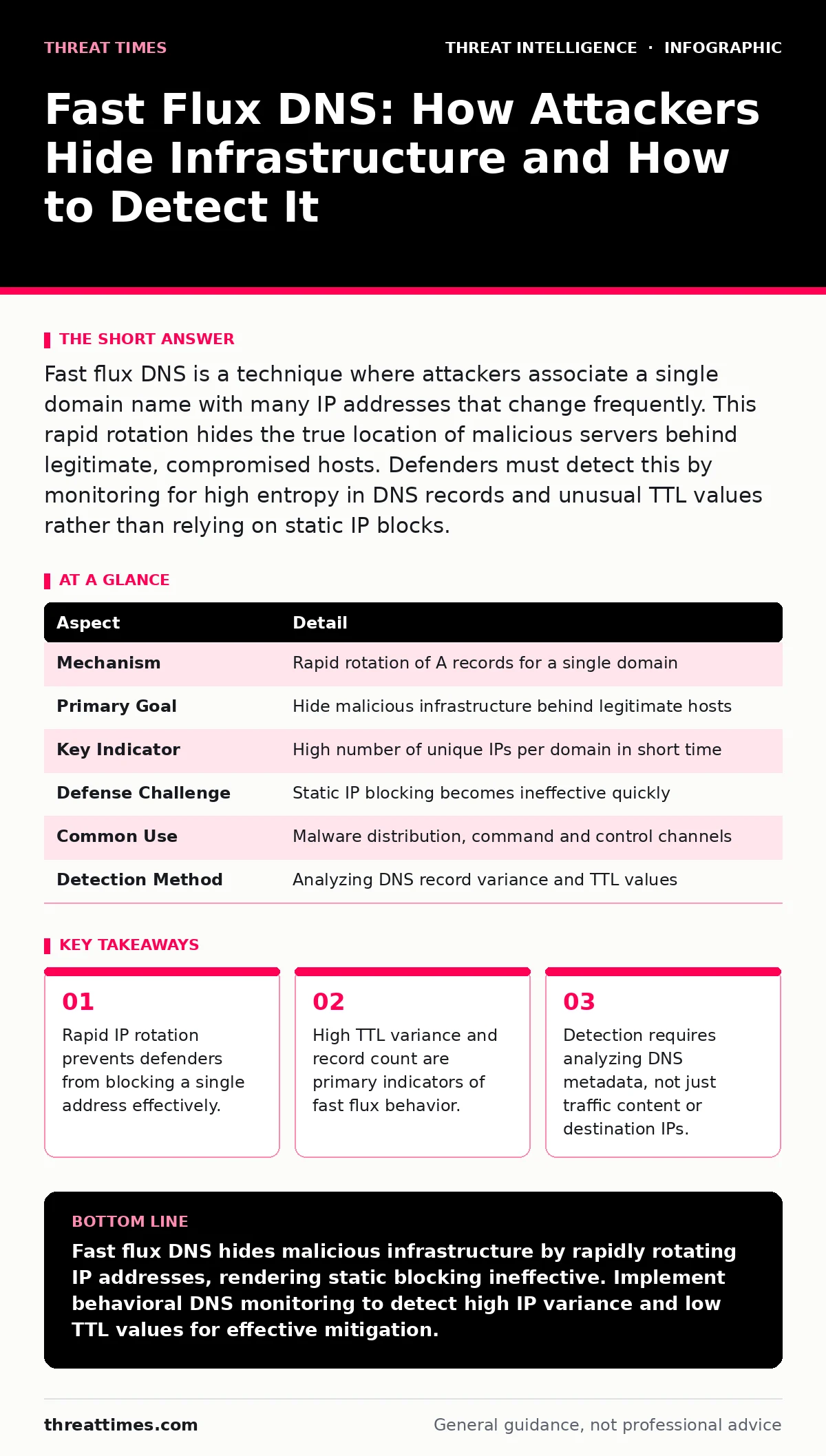
Fast flux DNS is a technique where attackers associate a single domain name with many IP addresses that change frequently. This rapid rotation hides the true location of malicious servers behind legitimate, compromised hosts. Defenders must detect this by monitoring for high entropy in DNS records and unusual TTL values rather than relying on static IP blocks.
Everyday Analogy: The Moving Target
Imagine a courier service where the pickup address changes every five minutes. You cannot intercept the package at a single location because the location itself is fluid. The courier uses hundreds of different houses as temporary drop-off points. Each house belongs to a real owner who is unaware of the illegal activity. When authorities shut down one house, the operation immediately moves to the next. The service remains available because the network of locations is vast and constantly shifting. This fluidity protects the core operation from discovery and disruption.
What Is Fast Flux DNS
Fast flux DNS is a technique that associates a single domain name with a large set of IP addresses that change frequently. Attackers use this method to host malicious content on compromised legitimate servers. The domain resolves to different IPs at different times, often every few seconds or minutes. This rapid rotation makes it difficult for defenders to identify and block the actual infrastructure. The technique relies on the widespread nature of compromised devices to absorb blocking attempts.
| Aspect | Detail |
|---|---|
| Mechanism | Rapid rotation of A records for a single domain |
| Primary Goal | Hide malicious infrastructure behind legitimate hosts |
| Key Indicator | High number of unique IPs per domain in short time |
| Defense Challenge | Static IP blocking becomes ineffective quickly |
| Common Use | Malware distribution, command and control channels |
| Detection Method | Analyzing DNS record variance and TTL values |
How Fast Flux Works
The attacker registers a domain and configures its DNS records to point to many IP addresses. These IPs belong to compromised computers, often part of a botnet. The Time To Live (TTL) value for these DNS records is set very low. A low TTL forces resolvers to refresh the IP list frequently. When a user visits the domain, their system receives a new set of IPs each time. The traffic is distributed across thousands of machines. If a defender blocks one IP, the domain resolves to others. The service remains online because the underlying infrastructure is decentralized and constantly changing.
Who It Affects
Organizations with strict perimeter defenses face significant challenges from fast flux techniques. Traditional firewalls that rely on static IP blacklists fail to stop this traffic. The malicious traffic blends in with legitimate web requests. Users inside the network may unknowingly download malware or send data to command and control servers. The compromised hosts used in the flux network also suffer performance issues and potential legal scrutiny. These hosts are often residential IPs or small business servers. The owners of these machines are unaware their resources are being abused.
What People Usually Get Wrong
Many defenders assume that blocking a malicious IP is sufficient. This assumption fails against fast flux because the IPs change too quickly. Another common error is focusing only on the content of the traffic. The payload may look normal because it travels over standard HTTPS. The anomaly lies in the DNS resolution pattern, not the application layer data. Defenders often ignore DNS metadata because it seems less critical than firewall logs. This oversight allows fast flux domains to operate undetected for long periods.
See also: Build a Cyber Intelligence Program That Cuts Noise and Finds Threats · 7 Common Incident Response Runbook Errors And How To Fix Them
Detection Strategies
Effective detection requires monitoring DNS query patterns rather than just connection attempts. Look for domains that resolve to an unusually high number of unique IP addresses. A single domain returning dozens of IPs in a short timeframe is a strong indicator. Check the TTL values associated with these records. Fast flux domains often use TTLs of less than one hour. Compare the geographic distribution of the resolved IPs. Legitimate services usually host content in specific regions. Fast flux IPs are scattered globally, reflecting the distributed nature of the botnet.
Mitigation and Response
Blocking individual IPs is futile against fast flux. Instead, sinkhole the malicious domain at the DNS level. This redirects traffic to a safe server controlled by the defender. This method stops the malware distribution without needing to track every IP. Use threat intelligence platforms to share indicators of compromise with other organizations. Coordinate with ISPs to take down compromised hosts if possible. Update your incident response runbooks to include DNS-based containment steps. Ensure your security tools can parse and analyze DNS logs effectively.
The Role of Broader Intelligence
Fast flux networks often operate within larger campaigns. Understanding the context requires looking beyond the DNS records. Analyze the autonomous system numbers (ASNs) in threat intelligence to identify the networks hosting the IPs. This helps distinguish between compromised residential networks and dedicated hosting providers. Map the activity against the Unified Kill Chain to determine the stage of the attack. Early detection at the DNS stage prevents lateral movement. Combine these insights with a robust threat intelligence program to predict future infrastructure changes.
Why Static Defenses Fail
Static security controls rely on fixed indicators like IP addresses or file hashes. Fast flux techniques invalidate these indicators by design. The infrastructure is transient and distributed. Defenders must shift from static blocking to behavioral analysis. This requires continuous monitoring of DNS resolution patterns. It also demands automation to handle the volume of data. Manual investigation cannot keep pace with the rotation speed. Integrating these behaviors into your SOAR platforms allows for automated response. This reduces the time between detection and containment.
Key takeaways
- Rapid IP rotation prevents defenders from blocking a single address effectively.
- High TTL variance and record count are primary indicators of fast flux behavior.
- Detection requires analyzing DNS metadata, not just traffic content or destination IPs.
Fast flux DNS hides malicious infrastructure by rapidly rotating IP addresses, rendering static blocking ineffective. Implement behavioral DNS monitoring to detect high IP variance and low TTL values for effective mitigation.
Frequently asked questions
Can a firewall stop fast flux traffic?
Traditional firewalls that block specific IPs cannot stop fast flux traffic effectively. The IPs change too quickly for static rules to remain relevant. Firewalls must integrate with DNS filtering to block the domain itself.
What is the difference between fast flux and slow flux?
Fast flux rotates IP addresses every few minutes or seconds. Slow flux rotates IPs less frequently, such as hourly or daily. Both techniques use the same underlying mechanism of distributed infrastructure. Fast flux is more aggressive and harder to detect.
How do I identify a fast flux domain in my logs?
Look for domains that resolve to many unique IP addresses in a short period. Check for very low TTL values in the DNS records. Analyze the geographic spread of the IPs. A global distribution of IPs for a single domain is a strong indicator.
Is fast flux only used for malware distribution?
Fast flux is commonly used for malware distribution and command and control channels. Attackers also use it to host phishing pages or steal credentials. Any activity requiring resilient, hidden infrastructure can benefit from this technique.
How this guide was produced: written by the Threat Times editorial team with AI assistance, checked against the public references listed below, and reviewed when the facts change. See our editorial policy or report an error.