Build a Cyber Intelligence Program That Cuts Noise and Finds Threats
A cyber intelligence program turns raw data into actionable warnings, but most teams fail by hoarding indicators without defining the specific assets they must protect.

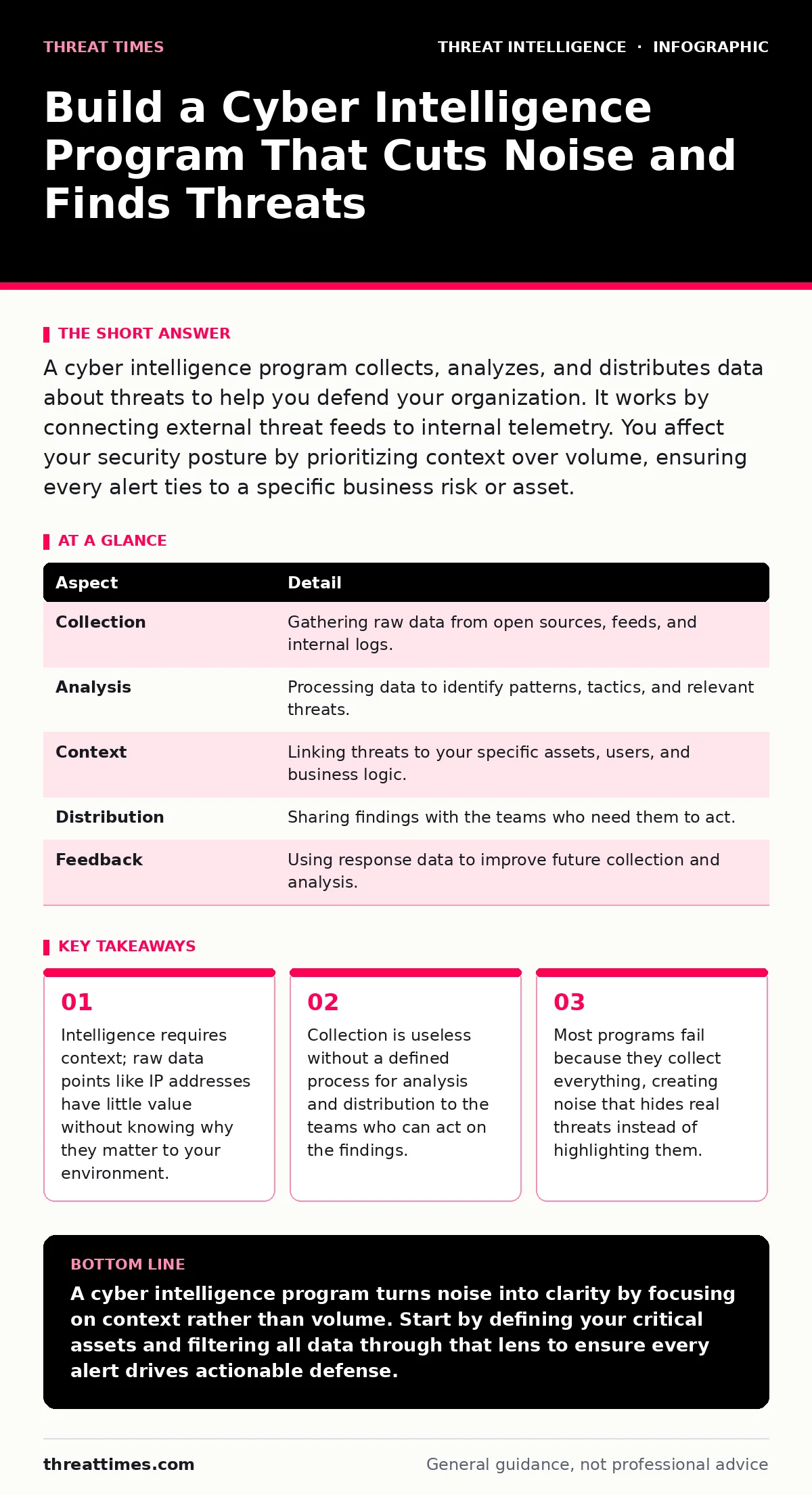
A cyber intelligence program collects, analyzes, and distributes data about threats to help you defend your organization. It works by connecting external threat feeds to internal telemetry. You affect your security posture by prioritizing context over volume, ensuring every alert ties to a specific business risk or asset.
What Is a Cyber Intelligence Program?
A cyber intelligence program is the structured process of collecting, analyzing, and sharing information about threats to protect your organization. It transforms raw data into actionable insights that help you prevent, detect, and respond to attacks. Without this program, you are defending against unknowns using only generic tools. With it, you tailor your defenses to the specific tactics used by adversaries who target your industry.
The difference between data and intelligence is context. An IP address is data. Knowing that IP address belongs to a group targeting your specific software stack is intelligence. Your program must bridge this gap. It connects external signals to internal risks. This connection allows you to prioritize alerts that matter and ignore those that do not.
At a Glance: Program Components
| Aspect | Detail |
|---|---|
| Collection | Gathering raw data from open sources, feeds, and internal logs. |
| Analysis | Processing data to identify patterns, tactics, and relevant threats. |
| Context | Linking threats to your specific assets, users, and business logic. |
| Distribution | Sharing findings with the teams who need them to act. |
| Feedback | Using response data to improve future collection and analysis. |
How a Cyber Intelligence Program Works
The program operates in a continuous loop. You start by defining what you need to know. This step is often skipped, leading to wasted effort. You must identify your crown jewels: the data, systems, and users that matter most. Once defined, you collect data that relates to these assets. This data comes from many sources. Open-source intelligence provides free information. Commercial feeds offer curated data. Internal logs show what is actually happening on your network.
Analysis is where the value is created. Analysts correlate external threats with internal activity. They look for indicators of compromise, which are artifacts like file hashes or domain names that suggest a breach. They also look for tactics, techniques, and procedures. These describe how an attacker behaves. Identifying behavior is more durable than identifying specific artifacts. Artifacts change; behavior persists.
Distribution ensures the right people get the right information. Security operations teams need real-time alerts. Management needs trend reports. Developers need to know about vulnerable libraries. If you send detailed technical reports to executives, they will ignore them. If you send high-level summaries to engineers, they cannot act. Precision in distribution is as important as precision in analysis.
Who It Affects and Why It Matters
A cyber intelligence program affects every layer of your organization. It changes how you build software, how you configure networks, and how you respond to incidents. It shifts security from a reactive stance to a proactive one. Instead of waiting for a breach, you anticipate likely attack paths.
For security operations, it reduces noise. By filtering out irrelevant threats, analysts can focus on real incidents. This reduces burnout and improves response times. For development teams, it informs secure coding practices. Knowing which libraries are targeted helps them patch faster. For leadership, it provides clarity on risk. They can see where threats align with business value. This alignment helps justify security spending.
The program also affects your external posture. By sharing threat data with peers, you contribute to a broader defense. This collaborative approach raises the cost for attackers. They must change tactics more often to bypass shared defenses. Isolation makes you a softer target. Connection makes you harder to hit.
Common Mistakes in Building a Cyber Intelligence Program
Many organizations treat a cyber intelligence program as a subscription service. They buy feeds and assume protection. This is a fundamental error. Feeds provide data, not intelligence. You must analyze that data. You must filter it through your context. Without analysis, you drown in alerts. This leads to alert fatigue. Teams stop looking at warnings because most are false positives.
Another mistake is collecting too much. Hoarding data creates storage costs and processing delays. It also hides signal in noise. You must collect only what you can use. Define your requirements clearly. If you do not need to know about threats to a different industry, ignore them. Focus on your sector. Focus on your technology stack. Relevance is more valuable than volume.
Finally, many teams fail to close the loop. They collect and analyze but do not feed insights back into the program. They do not update their collection criteria based on what they found. They do not share lessons learned from incidents. This stagnation causes the program to drift. It becomes outdated. It misses new trends. Continuous improvement is mandatory.
Integrating with Existing Security Tools
A cyber intelligence program does not work in isolation. It must integrate with your existing security stack. This integration automates the distribution of intelligence. You push indicators of compromise into your firewall. You update your endpoint detection systems. You configure your email gateway to block malicious domains. This automation speeds up defense. It reduces manual effort.
However, automation has limits. You cannot automate context. A firewall can block an IP address. It cannot decide if that IP address is part of a broader campaign targeting your specific application. Humans must make that decision. The program supports human judgment. It does not replace it. You need a balance of machine speed and human insight.
Consider how you handle autonomous system numbers (ASNs) in threat intelligence. An ASN identifies a network block. Knowing an attack comes from a specific ASN helps you understand the attacker's infrastructure. You can block entire ranges if needed. This is more effective than blocking single IPs. It requires deeper analysis than simple indicator matching.
What People Usually Get Wrong
People often confuse threat intelligence with vulnerability management. Vulnerability management finds flaws in your systems. Threat intelligence finds who is exploiting those flaws. Both are necessary. But they are different. You cannot fix every vulnerability. You must prioritize. Threat intelligence tells you which vulnerabilities are being actively exploited. This prioritization saves time and resources.
Another misconception is that more data equals better security. More data equals more work. It also equals more confusion. You need curated data. You need data that is clean, accurate, and relevant. Quality matters more than quantity. A small set of high-confidence indicators is better than a large set of noisy ones.
Finally, many believe that threat intelligence is only for large enterprises. Small organizations are targets too. Attackers often target smaller firms because they have weaker defenses. A scaled-down program can still provide value. Focus on the threats that matter to you. Use open-source resources. Share information with peers. Size does not determine risk. Exposure does.
Improving Your Response Capabilities
A cyber intelligence program enhances your incident response. It provides context during an attack. When you detect an intrusion, you need to know who is attacking and why. Intelligence gives you that context. It helps you understand the attacker's goals. It helps you predict their next moves. This foresight allows you to contain the breach faster.
It also improves your runbooks. Incident response runbooks are step-by-step guides for handling incidents. Intelligence updates these guides. If a new tactic emerges, you update the response steps. This ensures your team is prepared for current threats, not past ones. Static runbooks become obsolete quickly. Dynamic intelligence keeps them relevant.
The program also supports deception technology. By understanding attacker behavior, you can create honeypots that attract them. These traps waste attacker time. They provide early warning. They also generate high-fidelity data. This data improves your intelligence cycle. It creates a virtuous cycle of detection and defense.
Key takeaways
- Intelligence requires context; raw data points like IP addresses have little value without knowing why they matter to your environment.
- Collection is useless without a defined process for analysis and distribution to the teams who can act on the findings.
- Most programs fail because they collect everything, creating noise that hides real threats instead of highlighting them.
A cyber intelligence program turns noise into clarity by focusing on context rather than volume. Start by defining your critical assets and filtering all data through that lens to ensure every alert drives actionable defense.
Frequently asked questions
How do I measure the success of a cyber intelligence program?
Measure success by the reduction in false positives and the speed of response to confirmed threats. Track how often intelligence leads to a blocked attack or a patched vulnerability.
Do I need a dedicated team for this program?
You do not need a large team. A small group of analysts can manage the program if they focus on relevant data. Automation handles distribution. Human effort focuses on analysis.
How does this differ from a SIEM?
A SIEM collects and correlates logs. A cyber intelligence program provides the context for those logs. The SIEM shows what happened. The program explains why it matters and what to do next.
Can open-source tools support a cyber intelligence program?
Yes. Open-source tools can collect and analyze data. The value comes from your process, not your tools. Define your requirements clearly and filter data rigorously, regardless of the toolset.
How this guide was produced: written by the Threat Times editorial team with AI assistance, checked against the public references listed below, and reviewed when the facts change. See our editorial policy or report an error.