SPF vs DKIM: How Email Authentication Protocols Protect Your Domain
SPF validates the sending server address while DKIM cryptographically signs the message body, creating two distinct layers of defense against domain spoofing.

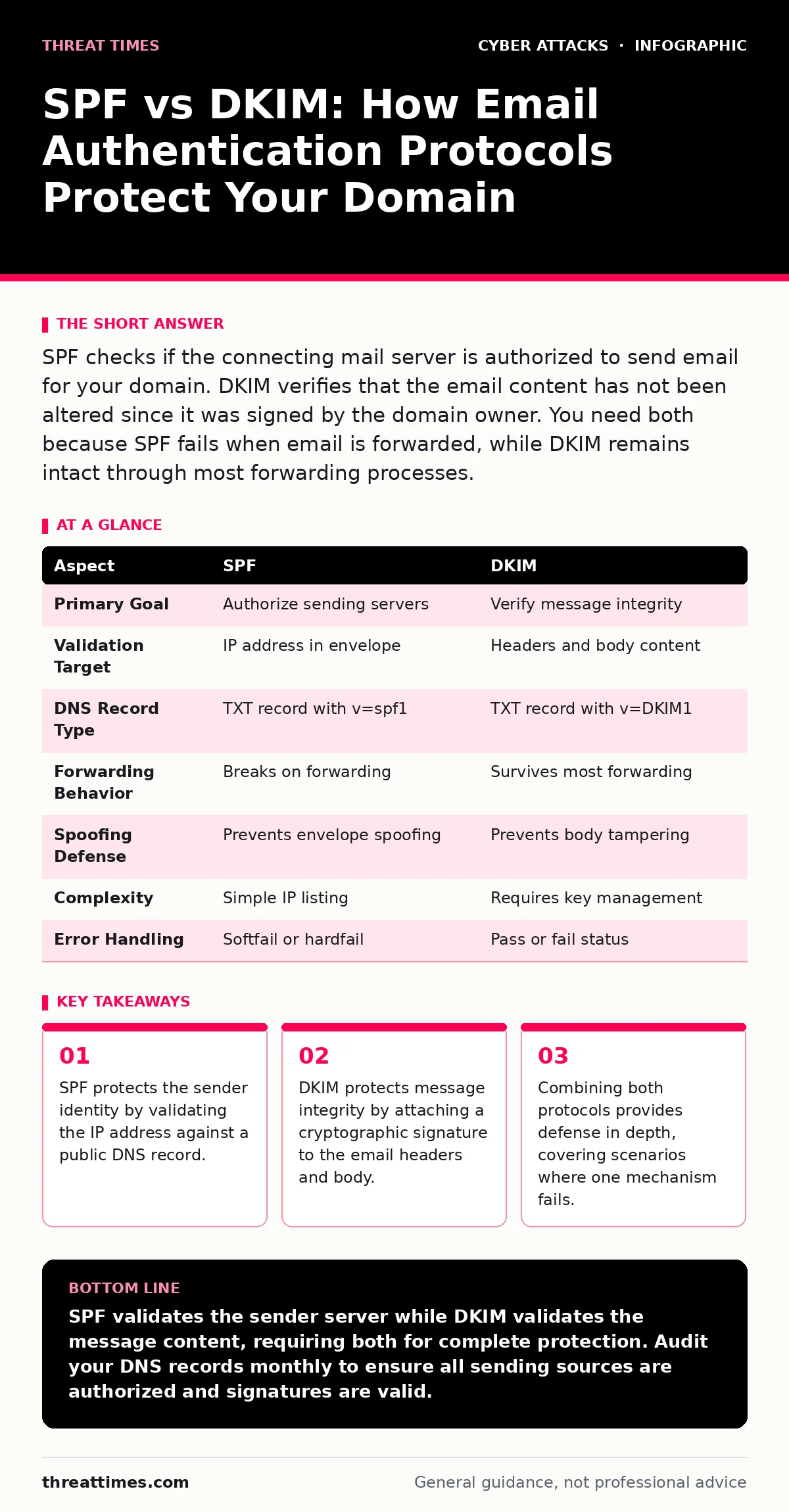
SPF checks if the connecting mail server is authorized to send email for your domain. DKIM verifies that the email content has not been altered since it was signed by the domain owner. You need both because SPF fails when email is forwarded, while DKIM remains intact through most forwarding processes.
The Core Difference Between SPF and DKIM
Sender Policy Framework (SPF) and DomainKeys Identified Mail (DKIM) serve different functions in email authentication. SPF answers the question of whether a specific server is allowed to send email on behalf of a domain. It relies on a DNS record that lists authorized IP addresses. DKIM answers the question of whether the email content has been tampered with. It uses a private key to sign the message and a public key in DNS to verify that signature. One validates the source; the other validates the content.
What SPF Does for Your Domain
SPF creates a whitelist of authorized sending servers. When a recipient receives an email, their mail server checks the SPF record published in the domain’s DNS. It compares the IP address of the connecting server against this list. If the IP matches, the check passes. If it does not match, the check fails. This mechanism prevents attackers from simply claiming to be your domain in the SMTP envelope. It does not protect the email body from modification. It only protects the claim of who sent it.
What DKIM Does for Your Domain
DKIM attaches a digital signature to specific headers and the body of the email. The sender’s mail server generates this signature using a private key. The recipient’s server retrieves the corresponding public key from the domain’s DNS records. It then recalculates the signature and compares it to the one attached to the email. If they match, the message is authentic and unaltered. This proves the message came from the domain owner and was not changed in transit. It works even if the email is forwarded, as long as the forwarding server does not strip the signature headers.
Point-by-Point Comparison of Mechanisms
| Aspect | SPF | DKIM |
|---|---|---|
| Primary Goal | Authorize sending servers | Verify message integrity |
| Validation Target | IP address in envelope | Headers and body content |
| DNS Record Type | TXT record with v=spf1 | TXT record with v=DKIM1 |
| Forwarding Behavior | Breaks on forwarding | Survives most forwarding |
| Spoofing Defense | Prevents envelope spoofing | Prevents body tampering |
| Complexity | Simple IP listing | Requires key management |
| Error Handling | Softfail or hardfail | Pass or fail status |
Choose SPF When You Control Sending Infrastructure
Choose SPF when you need to define exactly which servers can send email for your domain. This is the first line of defense against basic spoofing attempts. Use SPF if your organization sends email directly from its own servers without complex third-party integrations. It is effective for blocking obvious imposters who try to use your domain name in the SMTP transaction. SPF is straightforward to implement and easy to audit. You simply list the IP addresses or services you trust. It provides immediate visibility into who is claiming to be you.
Choose DKIM When Content Integrity Matters
Choose DKIM when you need to prove that the email content has not been altered. This is critical for transactional emails, such as password resets or billing statements. Use DKIM if your email passes through multiple servers or marketing platforms before reaching the recipient. DKIM ensures that the message the recipient reads is exactly what you sent. It protects against subtle attacks where an attacker modifies the body of the email to add malicious links or instructions. DKIM also helps with deliverability, as many providers trust signed emails more than unsigned ones.
Where SPF and DKIM Overlap and Complement
SPF and DKIM overlap in their reliance on DNS for verification. Both require you to publish records in your domain’s DNS zone. Both are used by receiving servers to decide whether to accept or reject an email. They complement each other by covering different failure modes. SPF fails when email is forwarded because the original sending IP is lost. DKIM succeeds in these cases because the signature travels with the message. Conversely, DKIM can be bypassed if an attacker compromises the private key. SPF remains effective in this scenario because the attacker’s IP would not be in the authorized list. Using both creates a robust authentication framework.
Implementation Best Practices for Defense in Depth
Implementing both protocols requires careful planning. Start by publishing your SPF record with the correct mechanisms. Ensure you include all third-party services that send email on your behalf. Then, generate DKIM keys and publish the public key in DNS. Configure your mail servers to sign outgoing messages. Test your configuration using diagnostic tools to ensure records are readable and signatures are valid. Monitor your email logs for authentication failures. Address any issues promptly to maintain trust with receiving providers. This layered approach significantly reduces the risk of successful impersonation attacks.
Consider how these mechanisms interact with other security measures. For instance, vendor email compromise often relies on bypassing basic authentication checks. Strong SPF and DKIM implementation makes these attacks harder to execute. Similarly, security culture training helps users recognize emails that lack proper authentication headers.
While firewalls protect network perimeters, email authentication protects the identity layer. Together, they form a cohesive defense strategy. Understanding the limits of each tool allows you to build a more resilient email infrastructure. Do not rely on a single mechanism. Layer your defenses to cover the gaps inherent in each protocol.
Key takeaways
- SPF protects the sender identity by validating the IP address against a public DNS record.
- DKIM protects message integrity by attaching a cryptographic signature to the email headers and body.
- Combining both protocols provides defense in depth, covering scenarios where one mechanism fails.
SPF validates the sender server while DKIM validates the message content, requiring both for complete protection. Audit your DNS records monthly to ensure all sending sources are authorized and signatures are valid.
Frequently asked questions
Does SPF protect against phishing emails?
SPF only prevents attackers from using your domain in the envelope sender field. It does not stop phishing emails that use a different domain or bypass SPF checks through forwarding.
Can I use SPF without DKIM?
Yes, but it is not recommended. SPF fails when email is forwarded, leaving gaps in authentication. DKIM provides continuity and content integrity that SPF cannot offer alone.
What happens if SPF and DKIM both fail?
Receiving servers may reject the email or mark it as spam. This depends on their policy settings. DMARC records define the specific action to take when both checks fail.
Do I need to update SPF records for every new service?
Yes, every service that sends email on your behalf must be included in your SPF record. Failure to do so will cause authentication failures for those messages.
How this guide was produced: written by the Threat Times editorial team with AI assistance, checked against the public references listed below, and reviewed when the facts change. See our editorial policy or report an error.