What Is Secure File Transfer Protocol: Mechanisms, Risks, and Implementation
Secure file transfer protocols encrypt data in transit but often fail to protect files resting on shared drives, creating a hidden gap in your defense strategy.

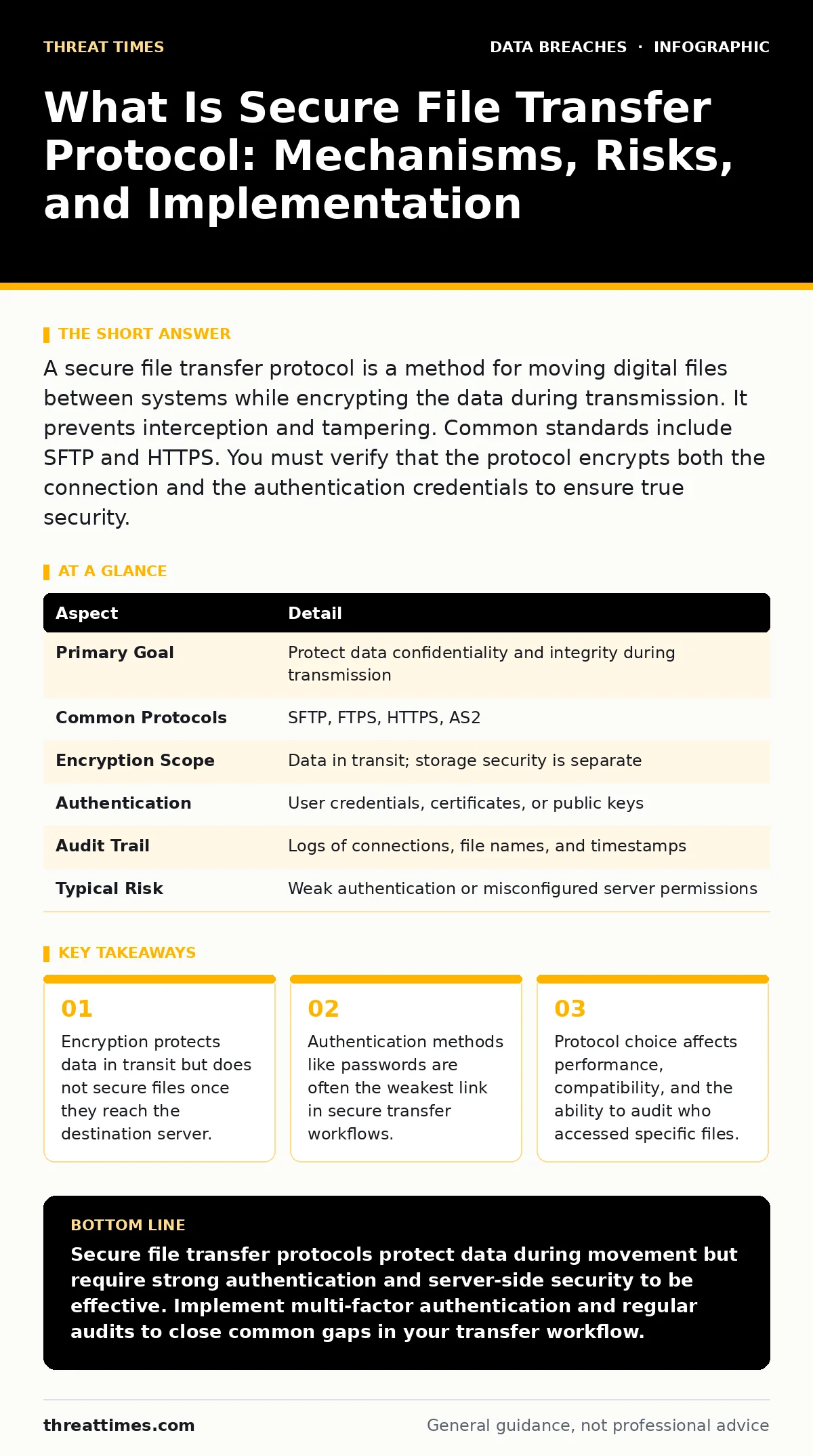
A secure file transfer protocol is a method for moving digital files between systems while encrypting the data during transmission. It prevents interception and tampering. Common standards include SFTP and HTTPS. You must verify that the protocol encrypts both the connection and the authentication credentials to ensure true security.
The Mechanics of Moving Data Safely
Imagine sending a sealed letter through a postal system where anyone can open the mailbox. The contents are exposed to theft or alteration. Secure file transfer protocols act as armored trucks for digital information. They wrap the data in encryption before it leaves the source system. The data remains unreadable until it reaches the intended recipient. This process protects against network sniffing and man-in-the-middle attacks.
| Aspect | Detail |
|---|---|
| Primary Goal | Protect data confidentiality and integrity during transmission |
| Common Protocols | SFTP, FTPS, HTTPS, AS2 |
| Encryption Scope | Data in transit; storage security is separate |
| Authentication | User credentials, certificates, or public keys |
| Audit Trail | Logs of connections, file names, and timestamps |
| Typical Risk | Weak authentication or misconfigured server permissions |
The core mechanism involves establishing a secure channel. The client and server negotiate encryption algorithms. They exchange keys to create a session. Once the tunnel is open, file data flows through it. The protocol ensures that packets are reassembled correctly. It also verifies that no data was altered during the journey.
What Is Secure File Transfer Protocol
A secure file transfer protocol is a set of rules that governs how files move between computers over a network while maintaining security. It answers the question of how to transfer data without exposing it to eavesdroppers. The term often refers specifically to SFTP, which runs over SSH. However, it broadly includes FTPS, which adds TLS to traditional FTP. It also covers HTTPS for web-based transfers. Each variant handles encryption and authentication differently.
SFTP uses a single port for both commands and data. This simplifies firewall configuration. FTPS uses separate ports for control and data channels. This can complicate network setups but offers backward compatibility with legacy systems. HTTPS is the most common method for browser-based uploads. It relies on web servers and standard HTTP methods.
Common Protocols and Their Trade-offs
Choosing the right protocol depends on your infrastructure and threat model. SFTP is widely supported and integrates well with Unix-based systems. It provides strong encryption and reliable file integrity checks. FTPS is useful when you must interact with older systems that do not support SSH. It requires careful configuration to handle passive mode connections through firewalls.
HTTPS is ideal for user-facing applications. It leverages existing web infrastructure. It supports complex authentication flows like OAuth. However, it may lack fine-grained control over file permissions compared to dedicated file transfer services. AS2 is used for business-to-business transactions. It ensures non-repudiation and receipt confirmation. It is complex to implement but necessary for regulated industries.
Who Is Affected by Insecure Transfers
Any organization that moves sensitive data is at risk. Healthcare providers sending patient records face strict compliance requirements. Financial institutions transferring transaction data must prevent fraud. Software developers sharing source code protect intellectual property. Even casual users sending tax documents expose themselves to identity theft.
The impact extends beyond data loss. Reputational damage occurs when users trust a service that fails to protect their files. Legal liabilities arise from regulatory violations. Operational disruptions happen when transfers fail due to misconfiguration. Understanding who holds the data and who receives it is critical for risk assessment.
What To Do About Transfer Security
Implementing secure transfers requires more than choosing a protocol. You must configure the server correctly. Disable anonymous access. Enforce strong authentication. Use multi-factor authentication where possible. Regularly update the software to patch vulnerabilities. Monitor logs for unusual activity.
Integrate secure transfer into your broader security strategy. Combine it with full disk encryption to protect data at rest. Use tokenization for sensitive fields like credit card numbers. Implement user access provisioning to ensure only authorized personnel can upload or download files. Review permissions periodically to remove stale accounts.
What People Usually Get Wrong
A common misconception is that SFTP is inherently secure against all threats. It is not. If you use a weak password, attackers can brute-force their way in. If you do not verify the server's host key, you may connect to an impersonator. Another error is assuming that encryption protects the file after it lands on the server. It does not.
Many organizations neglect audit trails. They do not log who accessed which files. This makes it impossible to investigate a breach. They also fail to rotate credentials regularly. Stale passwords remain valid for years, increasing the risk of compromise. Addressing these gaps is as important as choosing the right protocol.
EXAMPLE: A Hypothetical Breach Scenario
Suppose a marketing team uses FTPS to share campaign assets with an external agency. They use simple passwords for convenience. An attacker intercepts the control channel and captures the credentials. They log in later and exfiltrate unreleased product images. The team notices missing files only after a competitor releases a similar campaign. The breach occurred because authentication was weak, not because the encryption failed.
Integrating With Broader Security Practices
Secure file transfer is one component of data security. It must work with other controls. SOC 2 compliance requires strict controls over data access and transfer. Ensure your transfer solution meets these standards. Respect data subject rights by allowing users to request deletion of their files. Implement digital forensics capabilities to trace unauthorized access.
Avoid relying on password rotation as a primary defense. It is often cumbersome and ineffective against automated attacks. Use credential dumps analysis to detect leaked credentials. Combine these practices with secure file transfer to create a layered defense. This approach reduces the likelihood of successful breaches.
Key takeaways
- Encryption protects data in transit but does not secure files once they reach the destination server.
- Authentication methods like passwords are often the weakest link in secure transfer workflows.
- Protocol choice affects performance, compatibility, and the ability to audit who accessed specific files.
Secure file transfer protocols protect data during movement but require strong authentication and server-side security to be effective. Implement multi-factor authentication and regular audits to close common gaps in your transfer workflow.
Frequently asked questions
Is SFTP the same as FTPS?
No. SFTP runs over SSH and uses a single port, while FTPS adds TLS to traditional FTP and uses separate ports for control and data.
Does secure file transfer protect files on the server?
No. It only encrypts data in transit. You must use additional measures like full disk encryption to protect files at rest.
Can I use HTTPS for large file transfers?
Yes. HTTPS supports large uploads, but performance may vary. Dedicated protocols like SFTP or AS2 may be better for bulk transfers.
How do I verify the server's identity?
Check the server's host key or certificate fingerprint. Ensure it matches a known good value to prevent man-in-the-middle attacks.
How this guide was produced: written by the Threat Times editorial team with AI assistance, checked against the public references listed below, and reviewed when the facts change. See our editorial policy or report an error.