Quantum Computing and Encryption: How Qubits Break Classical Keys
Quantum computers exploit superposition to solve mathematical problems that secure modern internet traffic, rendering current encryption methods obsolete.

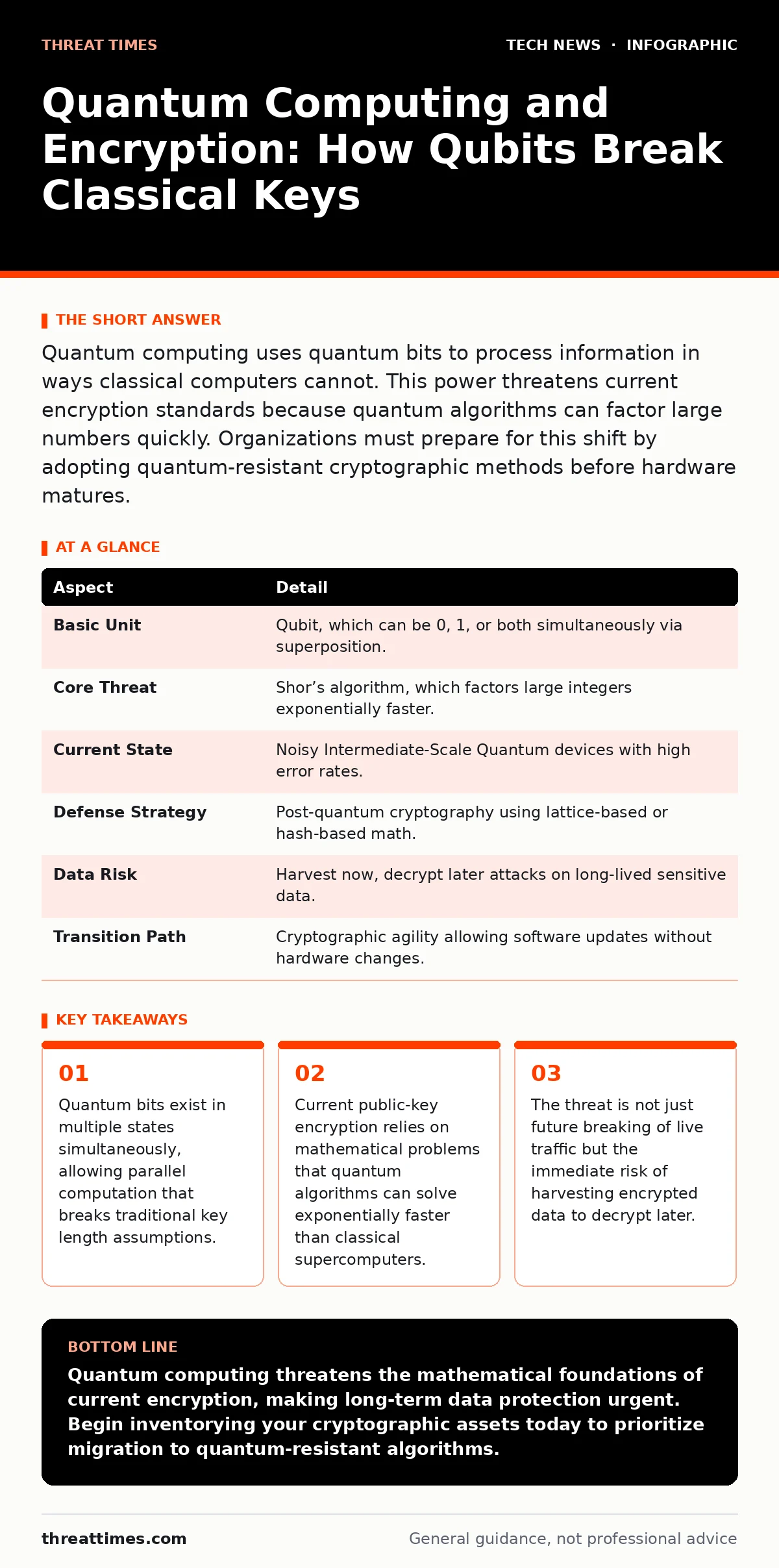
Quantum computing uses quantum bits to process information in ways classical computers cannot. This power threatens current encryption standards because quantum algorithms can factor large numbers quickly. Organizations must prepare for this shift by adopting quantum-resistant cryptographic methods before hardware matures.
The Superposition Mechanism
Imagine a coin spinning on a table. While it spins, it is neither heads nor tails but a combination of both. It only settles into one state when it stops. Classical computers use bits that are either zero or one, like a coin lying flat. Quantum computers use qubits that maintain that spinning state, known as superposition. This allows a quantum system to hold and process a vast number of possibilities at once.
This mechanism changes how problems are solved. A classical computer checks each possibility sequentially. A quantum computer evaluates them in parallel. For encryption, this parallelism is disruptive. It turns problems that would take millennia for a classical machine into tasks that take hours or minutes. The security of the internet currently rests on the assumption that certain math problems are too hard to solve quickly. Quantum computing invalidates that assumption.
| Aspect | Detail |
|---|---|
| Basic Unit | Qubit, which can be 0, 1, or both simultaneously via superposition. |
| Core Threat | Shor’s algorithm, which factors large integers exponentially faster. |
| Current State | Noisy Intermediate-Scale Quantum devices with high error rates. |
| Defense Strategy | Post-quantum cryptography using lattice-based or hash-based math. |
| Data Risk | Harvest now, decrypt later attacks on long-lived sensitive data. |
| Transition Path | Cryptographic agility allowing software updates without hardware changes. |
Why Current Encryption Fails
Most secure connections on the internet use public-key cryptography. This system uses two keys: one public for encryption and one private for decryption. The security relies on the difficulty of factoring large prime numbers. If you multiply two large primes, it is easy. If you have the result, finding the original primes is computationally intensive. This asymmetry is the foundation of SSL/TLS certificates and digital signatures.
Quantum algorithms change the cost of this factorization. Shor’s algorithm can find the prime factors of a large number in polynomial time. This means the time required to break the key grows slowly as the key size increases, rather than exponentially. A key that is secure against a classical supercomputer is vulnerable to a sufficiently powerful quantum computer. Symmetric encryption, which uses the same key for both ends, is less affected. Grover’s algorithm provides a quadratic speedup, meaning you can double the key size to maintain security.
The Harvest Now, Decrypt Later Reality
The most immediate danger is not a quantum computer breaking your password today. It is the theft of encrypted data that remains valuable for years. Intelligence agencies and organized criminals understand that data has a long shelf life. Financial records, health information, and trade secrets do not expire quickly. By capturing encrypted traffic now, attackers position themselves to decrypt it once quantum hardware matures.
This shifts the threat model from protecting live sessions to protecting stored data. You must assume that any data you encrypt today with standard algorithms will be exposed in the future. This applies to backups, archived emails, and long-term contracts. The window of opportunity for attackers is open now. They do not need to break the encryption today; they only need to store it securely.
This reality forces a change in data classification. Not all data needs quantum-resistant protection immediately. Data that loses value in months does not require the same safeguards as data that remains sensitive for decades. You must categorize your information based on its lifespan and sensitivity. This helps prioritize which systems need urgent updates to post-quantum standards.
Common Misconceptions About Quantum Threats
Many professionals believe that quantum computing is a distant problem. They assume that building a fault-tolerant quantum computer with thousands of logical qubits is decades away. While large-scale error-corrected machines are not here yet, the software preparation takes years. Migrating cryptographic systems is slow and complex. Waiting until the hardware arrives means you are already behind.
Another mistake is assuming that quantum computers break all encryption equally. They primarily threaten public-key systems like RSA and Elliptic Curve Cryptography. Symmetric algorithms like AES are more resilient. Doubling the key length from 128 to 256 bits restores security against Grover’s algorithm. This nuance is critical for planning. You do not need to replace every cryptographic primitive. You focus on key exchange and digital signatures first.
The Path to Post-Quantum Cryptography
The solution is not to wait for quantum hardware to fail. It is to adopt post-quantum cryptography. These are new mathematical algorithms designed to be secure against both classical and quantum computers. They rely on problems like lattice reduction, multivariate equations, or code-based cryptography. These problems do not have known efficient quantum algorithms.
Standardization bodies are finalizing these algorithms. You will see them integrated into software updates, operating systems, and network equipment. The transition requires cryptographic agility. This means your systems must be able to swap out cryptographic algorithms without replacing hardware. If your device is locked to a specific algorithm, you cannot update it remotely. You must replace the physical device, which is costly and disruptive.
Integrating Quantum Readiness Into Security
Quantum readiness is not a separate project. It is part of your overall security hygiene. It intersects with other domains you likely already manage. For instance, certificate management practices must evolve to handle new key formats and sizes. Your Public Key Infrastructure must support the issuance and validation of post-quantum certificates.
Similarly, edge computing security becomes more complex. Devices at the network edge often have limited processing power. Post-quantum algorithms can be computationally heavier than current ones. You must ensure that your edge devices can handle the increased overhead without degrading performance. This requires careful testing and possibly hardware upgrades.
Virtualization security also plays a role. Hypervisors manage cryptographic operations for many virtual machines. If the hypervisor supports post-quantum algorithms, all guest machines benefit. This centralizes the update process. However, it also creates a single point of failure. If the hypervisor’s implementation has a flaw, every VM is at risk. You must verify the security of the underlying platform.
Practical Steps for Implementation
Start by inventorying your cryptographic assets. List every system that uses public-key cryptography. Note the algorithm, key size, and lifespan of the data it protects. Prioritize systems that handle long-lived sensitive data. These are your highest risk.
Next, test post-quantum algorithms in a non-production environment. Measure the performance impact. Check for compatibility with your existing tools and protocols. You may find that some legacy systems cannot support the new key sizes. These systems may need to be decommissioned or isolated.
Finally, develop a migration plan. Do not attempt to switch everything at once. Move in phases. Start with external-facing services, then internal networks, then stored data. Communicate with your vendors to ensure they are also preparing. Security is a supply chain issue. If your vendor does not support post-quantum standards, your security is only as strong as their weakest link.
Key takeaways
- Quantum bits exist in multiple states simultaneously, allowing parallel computation that breaks traditional key length assumptions.
- Current public-key encryption relies on mathematical problems that quantum algorithms can solve exponentially faster than classical supercomputers.
- The threat is not just future breaking of live traffic but the immediate risk of harvesting encrypted data to decrypt later.
Quantum computing threatens the mathematical foundations of current encryption, making long-term data protection urgent. Begin inventorying your cryptographic assets today to prioritize migration to quantum-resistant algorithms.
Frequently asked questions
Will quantum computers break my Wi-Fi password?
If your network uses WPA3, the symmetric encryption is resilient to quantum attacks. However, the initial handshake may use vulnerable public-key methods. You should look for enterprise networks that support post-quantum key exchange.
Do I need to replace my laptop to be quantum safe?
No. Most post-quantum protections are software-based. You will receive updates to your operating system and applications. Ensure your laptop hardware can handle the increased computational load of new algorithms.
Is smart home security at risk from quantum computing?
Many smart home devices use weak encryption that is already vulnerable to classical attacks. The quantum threat is secondary to current poor security practices. Focus on strong passwords and network segmentation first.
How long until quantum computers are a real threat?
Fault-tolerant quantum computers capable of breaking RSA are likely years away. However, the harvest now, decrypt later risk is present today. You should prepare your data protection strategies now, not later.
How this guide was produced: written by the Threat Times editorial team with AI assistance, checked against the public references listed below, and reviewed when the facts change. See our editorial policy or report an error.