Nvidia Submits Liquid-Cooled Vera Rubin Designs to Open Compute Project
Nvidia shares rack designs for its AI platform at the OCP Global Summit, while Arm and Kioxia also announce new hardware standards and drives.
Key points
- Nvidia submitted liquid-cooled Vera Rubin rack designs to the Open Compute Project to standardize AI infrastructure.
- Arm released a white paper proposing a new methodology for measuring CPU performance in agentic AI systems.
- Kioxia unveiled its LD4 Series enterprise SSDs designed to increase storage density in high-density servers.
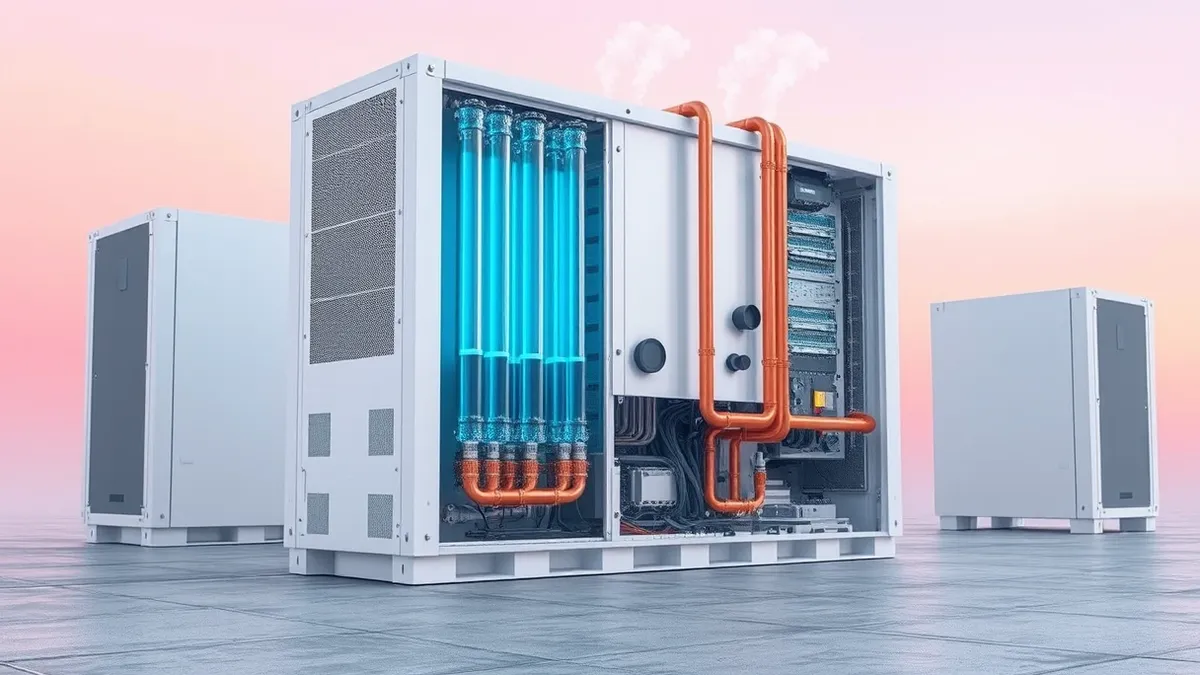
Nvidia submitted key rack and compute tray designs for its Vera Rubin platform to the Open Compute Project during the annual summit in San Jose, California. The company contributed these designs through its modular MGX architecture to provide a shared foundation for server vendors and infrastructure suppliers building AI systems.
The submitted designs feature a fully liquid-cooled system that eliminates the need for fans and internal cabling. According to Network World, this approach simplifies deployment and servicing of the hardware. The Open Compute Project focuses on developing open, efficient, and scalable hardware designs for data centers, covering power, cooling, networking, and AI accelerators.
New Performance Metrics and Storage
Arm released a white paper developed with partners that proposes a use-case-driven methodology for evaluating CPU contributions to agentic AI systems. The document defines five representative workload types, including software engineering, enterprise operations, financial research, personal assistants, and robotics. It pairs component-level benchmarking with end-to-end task measurements based on re-playable agent trajectories to assess performance more accurately.
Kioxia also announced new hardware at the summit, unveiling its LD4 Series enterprise solid-state drives. These drives are designed to increase flash storage density specifically for hyperscale data centers and high-density 1U servers. The announcement aligns with the summit’s focus on improving the physical infrastructure behind cloud computing and AI data centers.
Arm Performance Comparisons
Arm highlighted independent testing conducted by Signal65, which compared its AGI CPU against AMD’s Epyc Turin generation server processors. The testing focused on completed work under rack-level constraints rather than conventional CPU benchmarks alone. Signal65 found that the Arm AGI CPU could deliver up to twice the rack-level performance of the AMD processors across select agentic AI workloads.
In the specific testing scenarios, the Arm AGI CPU averaged 1.7 times better performance for tooling tasks. It achieved 2.0 times better performance for agentic workflows and orchestration, and 2.2 times better performance for reasoning and planning in modeled per-rack performance versus the AMD Epyc Turin processor. These figures emphasize efficiency within rack-level limits.
Arm stated that its AGI CPU reduces sandbox creation latency by up to 45 percent compared to the AMD Epyc 9965 processor. This reduction helps agents spin up isolated execution environments faster, which is critical for agentic AI systems that require rapid task switching. The comparison aims to show real-world utility rather than theoretical peak speeds.
What should you do?
Infrastructure planners should review the new OCP submissions to assess how liquid-cooled designs might impact their data center cooling strategies. Engineers working with agentic AI workloads should evaluate Arm’s new performance metrics to determine if their current CPU benchmarks accurately reflect end-to-end task efficiency. Storage administrators should consider the density benefits of the Kioxia LD4 Series for high-density server deployments.
What to do and how to stay safe: Nvidia
- Review the Open Compute Project’s published designs to understand how liquid cooling changes rack deployment and serviceability requirements.
- Evaluate your current CPU benchmarking methods against Arm’s proposed use-case-driven methodology to see if they align with agentic AI workload needs.
- Assess your storage density requirements to determine if high-density 1U servers and new enterprise SSDs fit your data center’s physical constraints.
- Monitor independent testing results from partners like Signal65 to validate performance claims before committing to new hardware architectures.
Step-by-step guide: Prompt Injection Warning Signs: How to Spot AI Manipulation
General security guidance from the Threat Times newsroom. It is not confirmed advice from the organisations named in this story.
Frequently asked questions
What is the main feature of Nvidia’s new Vera Rubin rack designs?
The designs are fully liquid-cooled, which eliminates the need for fans and cabling, making them easier to deploy and service.
How does Arm measure CPU performance for agentic AI?
Arm proposes a methodology that pairs component-level benchmarking with end-to-end task measurement built on re-playable agent trajectories across five workload types.
What storage product did Kioxia announce at the summit?
Kioxia unveiled its LD4 Series enterprise solid-state drives, designed to increase flash storage density in hyperscale data centers and high-density 1U servers.