What Are Data Subject Rights: Mechanics, Scope and Response
Data subject rights shift legal liability from the individual to the organization holding the record, creating strict operational deadlines for verification and deletion.

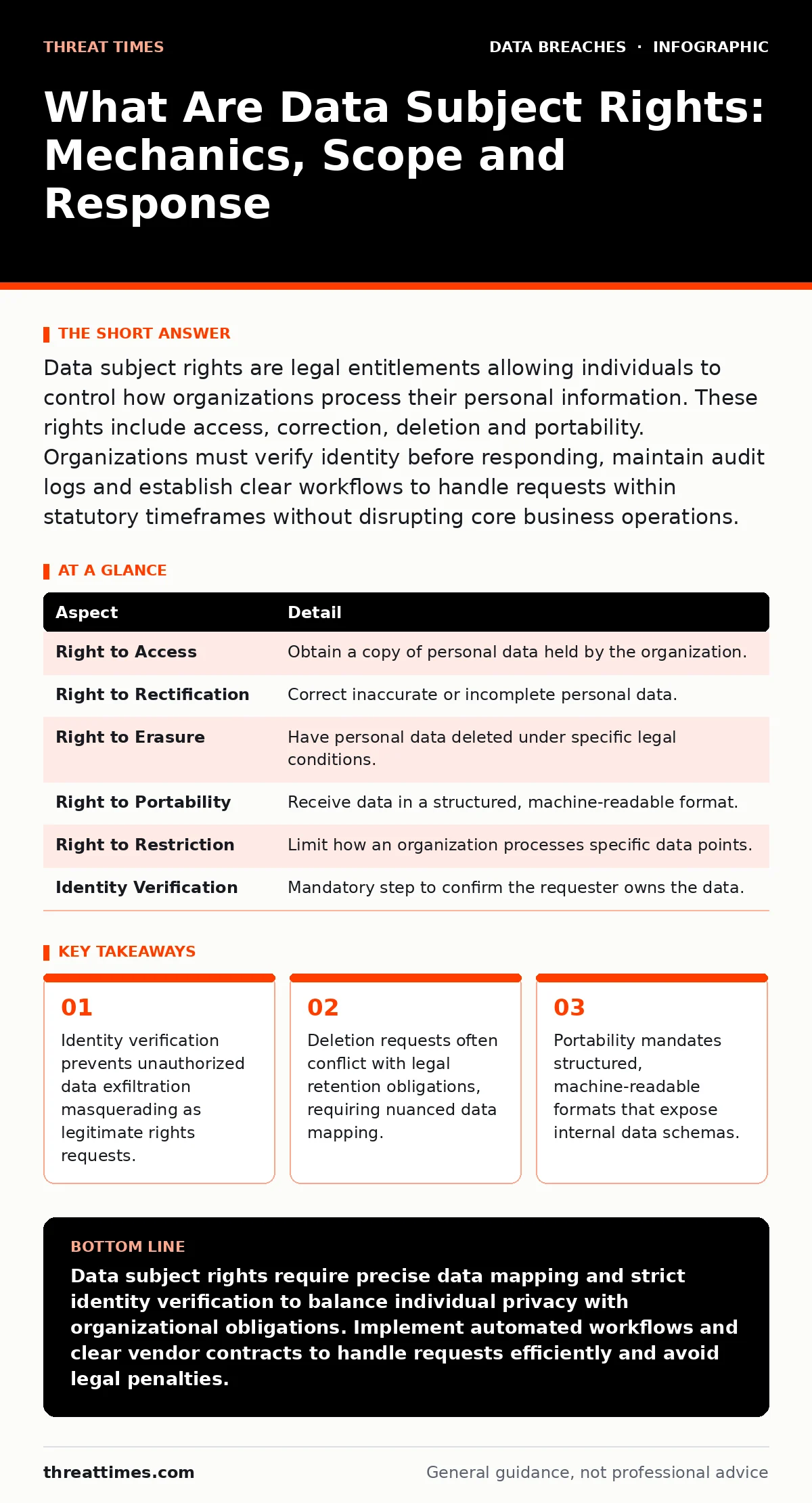
Data subject rights are legal entitlements allowing individuals to control how organizations process their personal information. These rights include access, correction, deletion and portability. Organizations must verify identity before responding, maintain audit logs and establish clear workflows to handle requests within statutory timeframes without disrupting core business operations.
Everyday Analogy: The Library Archive
Imagine a library that keeps a detailed ledger of every book every patron checks out. The patron can ask to see their own ledger entries. They can request corrections if a book is recorded as returned late when it was not. They can even ask the library to shred their specific ledger page. The library cannot simply hand over the entire archive because one person asked. It must isolate that person’s data, verify the requester’s identity and ensure no other legal obligations prevent the destruction. This analogy mirrors how data subject rights function in digital systems. The organization holds the infrastructure, but the individual holds the authority over their specific data trail.
What Are Data Subject Rights
Data subject rights are statutory powers granted to individuals regarding their personal data held by organizations. These rights exist to rebalance the power dynamic between data collectors and data subjects. The core rights typically include the right to access, the right to rectification, the right to erasure and the right to data portability. Some jurisdictions also include the right to restrict processing and the right to object. These rights are not suggestions. They are enforceable legal obligations that trigger specific technical and procedural responses from the organization holding the data.
| Aspect | Detail |
|---|---|
| Right to Access | Obtain a copy of personal data held by the organization. |
| Right to Rectification | Correct inaccurate or incomplete personal data. |
| Right to Erasure | Have personal data deleted under specific legal conditions. |
| Right to Portability | Receive data in a structured, machine-readable format. |
| Right to Restriction | Limit how an organization processes specific data points. |
| Identity Verification | Mandatory step to confirm the requester owns the data. |
How the Mechanism Works in Practice
The process begins when a data subject submits a request. The organization must first verify the identity of the requester. This step is critical. If you provide data to the wrong person, you have caused a breach. Verification methods vary by risk level. Low-risk requests might require matching an email address. High-risk requests, such as accessing medical or financial records, require multi-factor authentication or government-issued ID. Once verified, the organization must locate all instances of the data. This requires accurate data mapping. You must know where your data lives, including backups, third-party processors and archived emails.
Who Is Affected by These Rights
These rights affect any organization that processes personal data of individuals in jurisdictions with privacy laws. This includes global companies, local businesses and non-profits. The scope extends beyond customers. Employees, contractors and website visitors are also data subjects. The organization affected is not just the primary data collector. Data processors, such as cloud providers or marketing platforms, must also comply. If you use a third-party service to handle customer support, that service must assist you in fulfilling rights requests. The burden of compliance falls on the data controller, but the technical execution often requires cooperation from multiple vendors.
What to Do About Incoming Requests
Establish a centralized intake channel for rights requests. Do not rely on scattered email inboxes or social media messages. Create a standard operating procedure that triggers upon receipt. The first step is always identity verification. The second step is data location. Use your data inventory to find where the information resides. The third step is execution. For access requests, provide the data in a common format like JSON or CSV. For deletion requests, remove the data from active systems and mark it for removal from backups. Document every step. Audit trails are necessary to prove compliance if challenged.
See also: Generative AI Examples: Mechanisms, Risks and Control
Common Misconceptions About Rights
Many organizations assume that data subject rights mean immediate, unconditional deletion. This is incorrect. Deletion is subject to exceptions. Legal retention periods, contractual obligations and vital interests can override the right to erasure. Another misconception is that only primary systems need cleaning. Data often exists in analytics databases, customer support tickets and employee laptops. Failing to clean these secondary stores leaves residual data. This residual data can still be considered a violation if it is accessible or recoverable. Proper data governance requires cleaning the entire data lifecycle, not just the primary application database.
Integration With Security Controls
Data subject rights intersect with technical security measures. When verifying identity, you must balance security with privacy. Collecting more identification data than necessary creates new privacy risks. Use existing authentication mechanisms where possible. If you use tokenization, ensure that the tokens cannot be reversed without the vault, which may complicate access requests.
If you rely on full disk encryption, remember that encryption protects data at rest but does not prevent authorized access for rights requests. The security team must collaborate with legal and IT operations to ensure that access controls allow for compliant data retrieval and deletion.
Managing Third-Party Dependencies
Your vendors are your weak points. If you store customer data in a third-party cloud service, you must ensure that your contract allows you to fulfill rights requests. Many standard contracts do not include specific clauses for data portability or deletion. You need to negotiate these terms upfront. Without a contractual right to force deletion or access, you cannot comply with the law. Regularly audit your vendor list. Map each vendor to the data they hold. Update your data flow diagrams when you add or remove services. This mapping is the foundation of a responsive rights management program.
Building a Sustainable Process
Compliance is not a one-time project. It is an ongoing operational requirement. Integrate rights management into your software development lifecycle. Design systems that can isolate and export user data easily. This is known as privacy by design. It reduces the technical debt of manual data extraction later. Train staff to recognize rights requests. A customer service agent might receive a deletion request via chat. They must know how to route it to the compliance team. Automate where possible. Use scripts to locate data across databases. Monitor response times. Statutory deadlines are strict. Missing a deadline can result in significant penalties and reputational damage.
Key takeaways
- Identity verification prevents unauthorized data exfiltration masquerading as legitimate rights requests.
- Deletion requests often conflict with legal retention obligations, requiring nuanced data mapping.
- Portability mandates structured, machine-readable formats that expose internal data schemas.
Data subject rights require precise data mapping and strict identity verification to balance individual privacy with organizational obligations. Implement automated workflows and clear vendor contracts to handle requests efficiently and avoid legal penalties.
Frequently asked questions
Do I need to delete data if a user asks?
Not always. You must check for legal retention obligations or contractual requirements that may override the deletion request.
How do I verify a requester's identity?
Use secure methods appropriate to the sensitivity of the data, such as multi-factor authentication or verified government ID.
What format should I use for data portability?
Provide data in a structured, machine-readable format like JSON, CSV or XML that the user can easily reuse.
Can a third-party vendor refuse to delete data?
They can refuse if their contract does not obligate them to do so, which puts you in breach of privacy laws.
How this guide was produced: written by the Threat Times editorial team with AI assistance, checked against the public references listed below, and reviewed when the facts change. See our editorial policy or report an error.