SOC 2 Compliance: What It Means and How Auditors Verify Trust
SOC 2 audits examine how your controls actually operate over time, not just whether policy documents exist on a server.

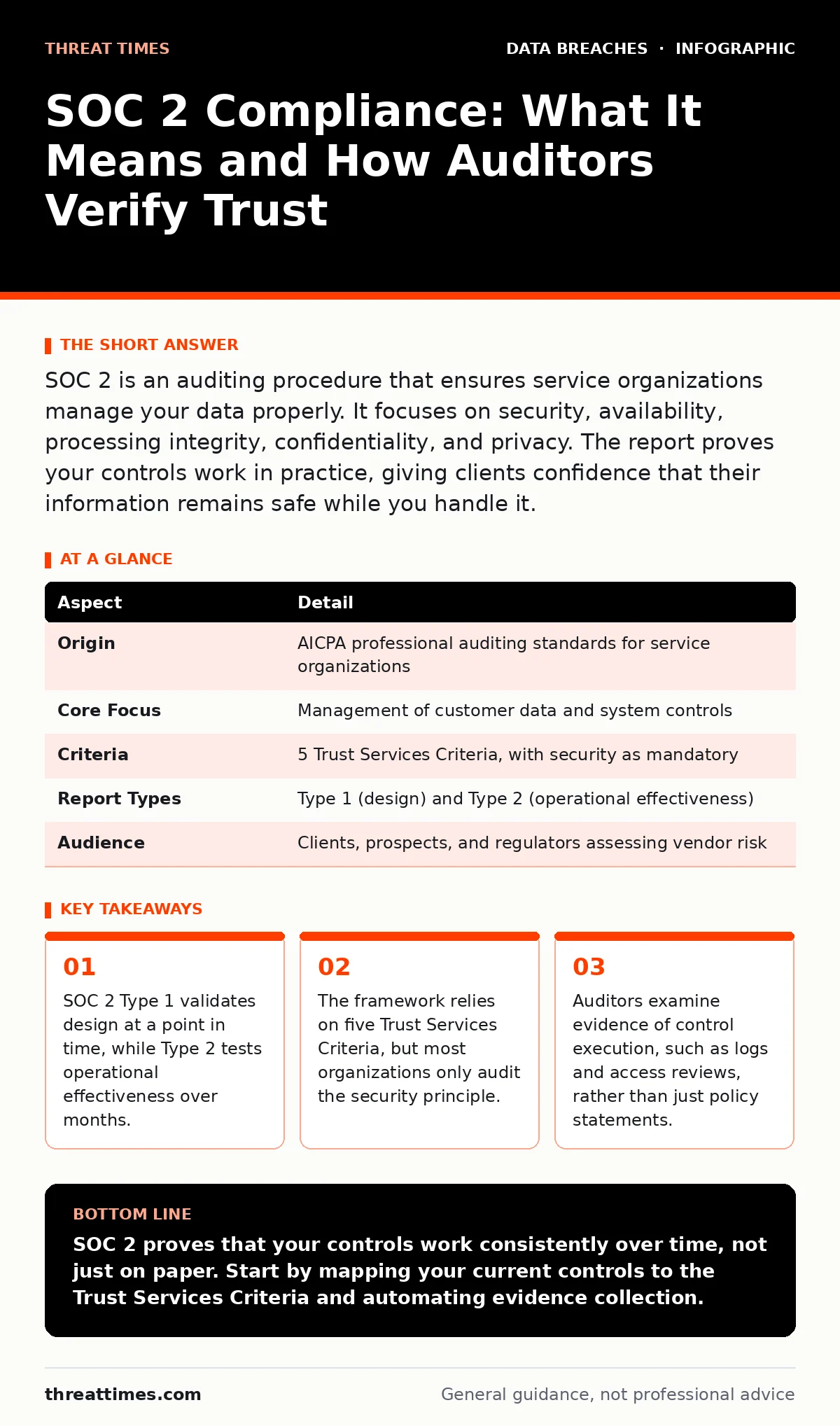
SOC 2 is an auditing procedure that ensures service organizations manage your data properly. It focuses on security, availability, processing integrity, confidentiality, and privacy. The report proves your controls work in practice, giving clients confidence that their information remains safe while you handle it.
The Lockbox Analogy for Data Custody
Imagine you hire a warehouse to store sensitive documents. You do not just ask if they have locks. You want to know who holds the keys, how often guards check the perimeter, and what happens if a lock breaks. SOC 2 operates on this same logic. It moves beyond static security checklists. It evaluates the ongoing behavior of your security controls. You prove that your safeguards function reliably when real users interact with your systems.
Defining the SOC 2 Framework
SOC 2 stands for Service Organization Control 2. It is a reporting framework created by the American Institute of Certified Public Accountants. The framework addresses how service organizations manage customer data. It focuses on five Trust Services Criteria. These are security, availability, processing integrity, confidentiality, and privacy. Security is the only mandatory criterion. It covers protection against unauthorized access. The other four are optional but often required by enterprise clients.
| Aspect | Detail |
|---|---|
| Origin | AICPA professional auditing standards for service organizations |
| Core Focus | Management of customer data and system controls |
| Criteria | 5 Trust Services Criteria, with security as mandatory |
| Report Types | Type 1 (design) and Type 2 (operational effectiveness) |
| Audience | Clients, prospects, and regulators assessing vendor risk |
Type 1 Versus Type 2 Reporting
Type 1 reports assess whether your control design is suitable at a specific date. An auditor reviews your policies. They check if the controls are properly designed to meet the criteria. This is a snapshot. It tells you that you have the right tools. It does not prove you use them correctly. Type 2 reports add a time element. Auditors test controls over a period of 3 to 12 months. They verify that the controls operated effectively throughout that window. Most enterprise buyers require Type 2. They need proof of consistent behavior, not just initial setup.
Daily Operations Under the Microscope
Auditors look for evidence of control execution. They do not accept your word that a process happens. They want logs, tickets, and records. You must demonstrate that user access provisioning follows strict approval workflows. When an employee leaves, their access must be revoked immediately. The auditor checks the timestamp of the revocation. They compare it to the HR record of termination. Any delay creates a finding. This daily rigor ensures that stale permissions do not linger.
The Hidden Cost of Scope Definition
Defining the scope of your audit is where many organizations stumble. You must list every system, application, and data flow in the report. If you miss a small tool, the auditor may expand the scope. This increases cost and effort. You must also decide which criteria to include. Adding privacy or availability increases the number of controls. It also increases the evidence required. A narrower scope is cheaper but may not satisfy client requirements. Balance client needs with operational reality. Do not promise coverage you cannot sustain.
See also: What Is Secure File Transfer Protocol: Mechanisms, Risks, and Implementation
What People Usually Get Wrong
Many teams treat SOC 2 as a one-time project. They build controls, pass the audit, and then relax. This is dangerous. Controls degrade without maintenance. Access reviews become lazy. Patching cycles slip. The next audit will catch these drifts. Another common error is assuming encryption solves everything. Full disk encryption protects data at rest. It does not stop an attacker who has valid credentials. You still need strong identity management. You must monitor for anomalous behavior. Encryption is a control, not a strategy.
Integrating Related Security Practices
SOC 2 requires you to tie your security practices together. You cannot have isolated controls. Secure file sharing mechanisms must align with your access policies. If you allow external transfers, you must log and review them. Tokenization can help meet confidentiality requirements. It replaces sensitive data with non-sensitive equivalents. This reduces the impact of a breach. However, you must still protect the token mapping system. The auditor will check how you manage that mapping.
Preparing for the Audit Cycle
Start by mapping your controls to the criteria. Identify the evidence for each control. Automate evidence collection where possible. Manual screenshots are tedious and error-prone. Use tools that generate continuous audit trails. Conduct a readiness assessment before the formal audit. This internal review catches gaps early. It saves money and reputation. Treat the audit as a business enabler. It builds trust with clients. It forces you to discipline your operations. This discipline reduces risk over time.
The Role of Digital Forensics
When a control fails, you need to understand why. Digital forensics helps you investigate incidents. It provides the evidence needed to determine scope and impact. If a breach occurs during the audit period, you must report it. The auditor will examine your response. Did you contain the threat? Did you notify affected parties? Your incident response plan must be tested. Drills prove that your team can execute under pressure. This preparation is part of the security criterion.
Maintaining Continuous Compliance
Compliance is a cycle, not a destination. You must review and update controls regularly. New systems require new controls. Changes in business processes affect existing controls. You must document these changes. The next audit will cover the new state. Keep your evidence current. Do not wait for the auditor to arrive. Build a culture of accountability. Every team member plays a role. This collective effort sustains trust. It protects your reputation and your customers.
Key takeaways
- SOC 2 Type 1 validates design at a point in time, while Type 2 tests operational effectiveness over months.
- The framework relies on five Trust Services Criteria, but most organizations only audit the security principle.
- Auditors examine evidence of control execution, such as logs and access reviews, rather than just policy statements.
SOC 2 proves that your controls work consistently over time, not just on paper. Start by mapping your current controls to the Trust Services Criteria and automating evidence collection.
Frequently asked questions
How long does a SOC 2 audit take?
The timeline depends on your scope and readiness. A Type 1 audit may take a few weeks. A Type 2 audit requires 3 to 12 months of operational evidence. The actual fieldwork might take 1 to 2 months.
Is SOC 2 a certification?
No, SOC 2 is a report, not a certification. An independent auditor issues the report. There is no issuing body that grants a certificate. You receive the report and share it with clients.
Can I do a SOC 2 audit internally?
You can perform a readiness assessment internally. However, the final report must come from an independent CPA firm. Internal audits lack the objectivity required for third-party trust.
What happens if I fail a SOC 2 audit?
You do not "fail" in a binary sense. The auditor issues a qualified opinion if controls are ineffective. You must remediate the gaps. You can then request a re-test or address it in the next cycle.
How this guide was produced: written by the Threat Times editorial team with AI assistance, checked against the public references listed below, and reviewed when the facts change. See our editorial policy or report an error.