What Is Privileged Account Management and Why It Protects Your Core Data
Privileged account management isolates high-level credentials from standard workflows, preventing lateral movement even when standard defenses fail.

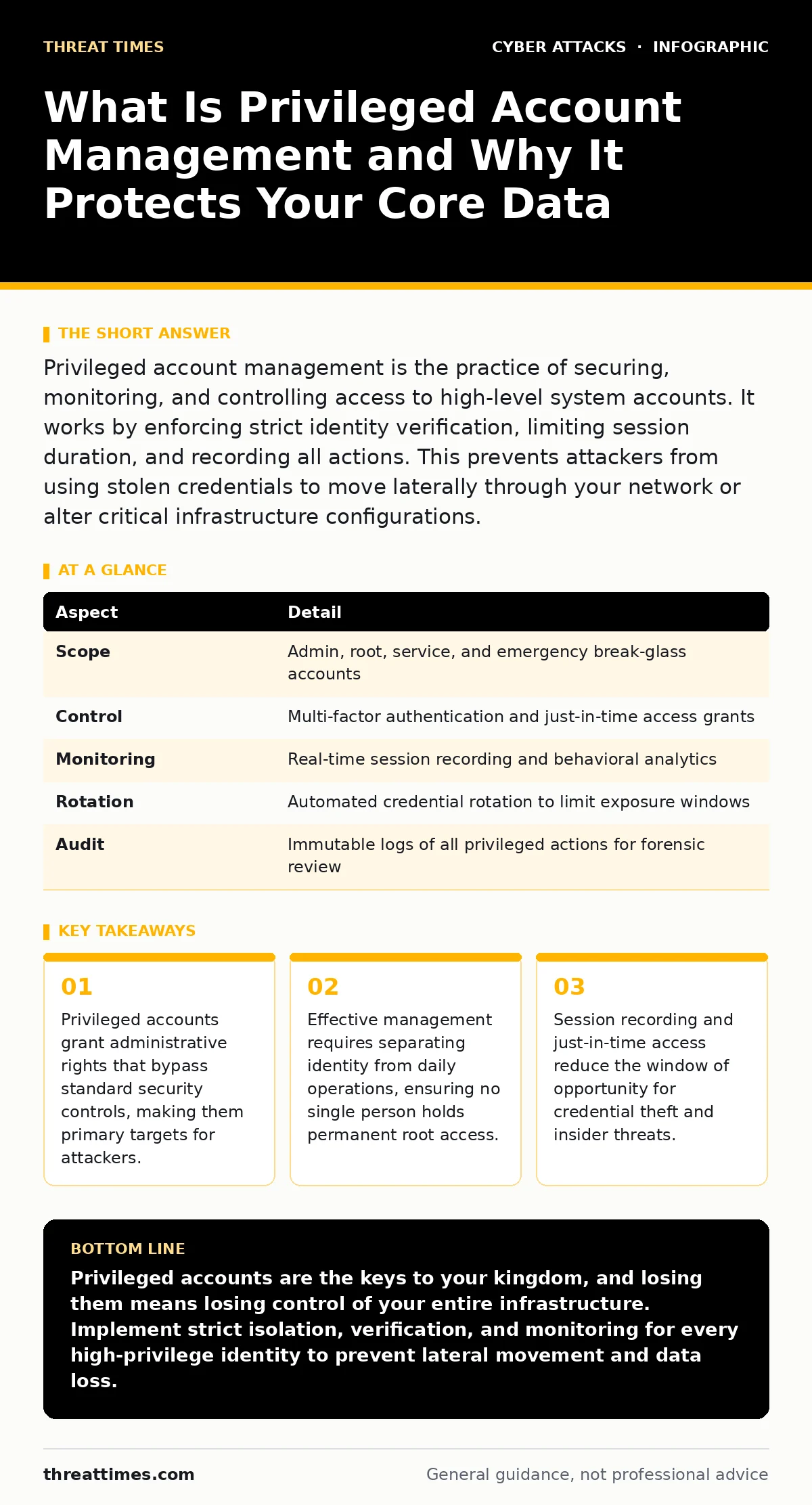
Privileged account management is the practice of securing, monitoring, and controlling access to high-level system accounts. It works by enforcing strict identity verification, limiting session duration, and recording all actions. This prevents attackers from using stolen credentials to move laterally through your network or alter critical infrastructure configurations.
The Library Card Analogy
Imagine a public library where every patron receives a standard card. These cards allow entry and access to general shelves. Now imagine a special key card that opens the restricted archives, the server room, and the staff offices. If a thief steals a standard card, they can only browse the public section. If they steal the special key, they can erase the catalog, steal rare books, and lock out the staff.
Privileged account management is the system that controls who holds that special key, when they can use it, and what they do with it. You do not hand out the master key to everyone. You issue it only when needed, under supervision, and you track every door it opens. This distinction separates routine access from administrative power. Most security breaches begin with the compromise of these high-value keys rather than the standard cards.
What Is Privileged Account Management
What is privileged account management? It is the framework of policies, technologies, and processes designed to protect accounts with elevated permissions. These accounts include system administrators, database owners, and service accounts that run automated tasks. Standard user accounts have limited rights, preventing accidental or malicious changes to core systems. Privileged accounts bypass these restrictions.
They can install software, modify security settings, and view sensitive data. Managing them requires a different approach than managing regular users. You cannot rely on simple password policies. You must enforce multi-factor authentication, limit session time, and monitor activity in real time. The goal is to ensure that only authorized personnel can perform critical actions, and that every action is logged for audit purposes.
| Aspect | Detail |
|---|---|
| Scope | Admin, root, service, and emergency break-glass accounts |
| Control | Multi-factor authentication and just-in-time access grants |
| Monitoring | Real-time session recording and behavioral analytics |
| Rotation | Automated credential rotation to limit exposure windows |
| Audit | Immutable logs of all privileged actions for forensic review |
How Privileged Access Works
The mechanism relies on isolation and verification. When an administrator needs access, they do not use a static password stored in a text file. They request access through a secure portal. The system verifies their identity using multiple factors, such as a hardware token and a biometric scan. Once verified, the system grants access for a limited duration, often just the time needed to complete a specific task.
This is known as just-in-time access. During the session, the system may record the screen activity or keystrokes. This creates an immutable log of what happened. If the administrator performs an unauthorized action, the system can terminate the session immediately. The credential is then rotated or revoked, rendering any stolen data useless. This process removes the human element of remembering strong passwords and storing them insecurely.
Who Is Affected by Privileged Access
Every organization with digital infrastructure is affected. This includes small businesses with a single server and large enterprises with cloud environments. The impact extends beyond IT staff. Developers, security analysts, and even third-party vendors often require elevated access to perform their jobs. Service accounts, which are non-human identities used by applications to communicate with databases, are also privileged.
These accounts are often overlooked but are highly attractive targets because they rarely expire and are rarely monitored. If an attacker compromises a service account, they can move laterally across the network without triggering standard alerts. This makes privileged access management relevant to every department that interacts with critical systems. Neglecting these accounts creates a single point of failure that can compromise the entire organization.
Common Misconceptions About Privileged Access
Many organizations believe that firewalls and intrusion detection systems are sufficient to protect privileged accounts. This is a dangerous assumption. Firewalls control traffic at the network perimeter, but they cannot stop an attacker who has already authenticated with valid credentials. Once inside, the attacker looks like a legitimate user. Standard security tools often ignore privileged activity to avoid alert fatigue.
This creates a blind spot. Another common mistake is assuming that multi-factor authentication alone solves the problem. MFA prevents initial unauthorized login, but it does not monitor what the user does after login. If an administrator falls for a social engineering attack and willingly hands over their session, MFA cannot stop the subsequent damage. You need continuous monitoring and least-privilege principles to address the post-login risk.
Implementing Effective Controls
Start by identifying all privileged accounts. This includes human and non-human identities. Create an inventory that details who owns each account, why it exists, and what permissions it holds. Remove any accounts that are no longer needed. Next, enforce multi-factor authentication for all privileged logins. Do not allow shared accounts where multiple people use the same credentials. Instead, use individual accounts that allow for precise auditing.
Implement just-in-time access, where privileges are granted only when needed and revoked immediately after. Use session recording to capture all actions. Finally, establish a break-glass procedure for emergency access. This procedure should require dual control, meaning two people must approve the access, and it should be heavily monitored. Regularly review these controls to ensure they remain effective.
The Hidden Cost of Convenience
Convenience is the enemy of security. Administrators often resist privileged access management because it adds steps to their workflow. They may create shortcuts, such as saving passwords in unencrypted files or disabling multi-factor authentication for local access. These shortcuts create vulnerabilities that attackers exploit. The hidden cost of these conveniences is the loss of accountability. When an incident occurs, you cannot determine who performed the action if multiple people share a credential.
You also cannot prove compliance with regulatory standards if you cannot demonstrate who accessed what and when. Investing in a robust privileged access management solution reduces this risk. It automates the tedious aspects of credential rotation and audit logging. This allows administrators to focus on their work while maintaining a secure environment. The trade-off is initial setup complexity for long-term security and compliance.
Key takeaways
- Privileged accounts grant administrative rights that bypass standard security controls, making them primary targets for attackers.
- Effective management requires separating identity from daily operations, ensuring no single person holds permanent root access.
- Session recording and just-in-time access reduce the window of opportunity for credential theft and insider threats.
Privileged accounts are the keys to your kingdom, and losing them means losing control of your entire infrastructure. Implement strict isolation, verification, and monitoring for every high-privilege identity to prevent lateral movement and data loss.
Frequently asked questions
How does privileged access management differ from standard identity management?
Standard identity management handles routine user access, while privileged access management focuses on high-privilege accounts that can alter system configurations and access sensitive data. It employs stricter controls like session recording and just-in-time access.
Can privileged access management prevent insider threats?
It mitigates insider threats by limiting the duration of access and recording all actions. While it cannot stop a determined insider, it reduces the opportunity for damage and provides evidence for forensic investigation.
Do service accounts need privileged access management?
Yes, service accounts often have high privileges and are rarely monitored. They are prime targets for attackers. Managing them with automated rotation and strict permission scoping is critical for network security.
Is multi-factor authentication enough for privileged accounts?
No, multi-factor authentication only secures the login process. It does not monitor activity after login or prevent abuse of valid credentials. You need additional controls like session monitoring and least-privilege enforcement.
How this guide was produced: written by the Threat Times editorial team with AI assistance, checked against the public references listed below, and reviewed when the facts change. See our editorial policy or report an error.