AMD reveals Helion rack design for AI agents at OCP Summit 2026
AMD introduced the Helion rack reference design at the Open Compute Project Summit, offering flexible CPU and GPU configurations for agentic AI workloads.
Key points
- AMD unveiled the Helion rack design at the OCP Summit 2026 in San Jose, California.
- The system supports CPU-only hyperscale setups or mixed CPU/GPU enterprise configurations.
- Partners are expected to deliver hardware based on this blueprint in November.
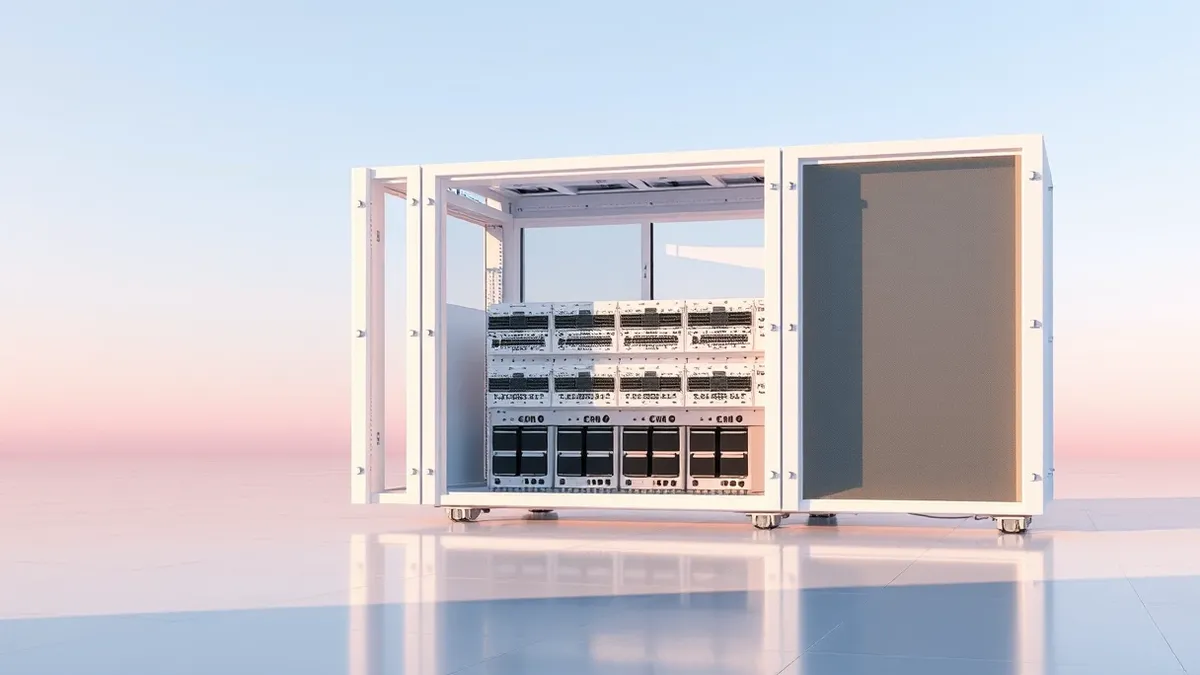
AMD unveiled its new Helion rack reference design at the Open Compute Project Summit 2026 in San Jose, California. The chipmaker announced that hardware partners will begin delivering systems based on this blueprint in November. This launch expands AMD’s rack-scale AI portfolio with a structure specifically intended for running AI agents.
The Helion design offers customers two primary deployment paths: a CPU-only hyperscale configuration and an enterprise configuration that mixes CPU and GPU blades. According to The Register, these systems can include liquid cooling or air cooling options. AMD positions this new rack as a complement to its existing Helios system, which was launched earlier this year for frontier-scale training and large-scale inference tasks.
Technical Specifications and Configurations
The Helion blueprint is built around AMD’s CPUs and accelerators, providing an OCP-compliant infrastructure for agentic AI. Depending on the chosen configuration, the system can deliver up to 32,768 Zen 6 CPU cores. These cores are provided through compute nodes equipped with 256-core versions of the Venice EPYC processor. The design also supports up to 16 Instinct MI350P GPU accelerators and offers up to 102 Tbps of networking bandwidth.
The CPU-only hyperscale version provides dedicated capacity for agent execution while connecting to separate model inference infrastructure. In contrast, the enterprise configuration combines agent execution, GPU inference, and supporting workloads within a single rack. This integration allows organizations to consolidate specific AI agent tasks without requiring separate physical infrastructure for inference.
Blade Options and Performance Tiers
AMD offers three types of CPU blades for dense, balanced, or high-performance deployments. Dense configurations utilize EPYC 9006 chips rated at 400 watts. Balanced blades employ 256-core processors rated at 600 watts. High-performance blades feature a version of the chip with 96 cores clocked at 5 GHz. These options allow customers to tailor their compute density and power consumption to specific workload requirements.
In addition to CPU blades, the Helion rack includes GPU inference blades. These consist of eight Instinct MI350P GPUs housed in a 5U server. The design also incorporates general-purpose blades intended for database operations, storage servers, or other technical compute workloads. This variety supports a broader range of enterprise IT needs beyond pure AI inference.
What should you do?
Security and technology professionals should monitor the November release window for partner hardware announcements. Organizations planning AI agent deployments should evaluate whether the CPU-only or mixed GPU configurations align with their existing data center cooling and power capabilities. IT leaders should also review their networking infrastructure to ensure it can support the high bandwidth requirements of these new rack designs.
What to do and how to stay safe: AMD
- Review current data center power and cooling capacity to determine if liquid or air-cooled Helion racks are feasible.
- Evaluate whether existing network infrastructure can support the high bandwidth demands of the new rack designs.
- Monitor partner announcements in November for specific hardware availability and pricing details.
- Assess whether CPU-only or mixed GPU configurations better suit your specific AI agent workload requirements.
Step-by-step guide: Prompt Injection Warning Signs: How to Spot AI Manipulation
General security guidance from the Threat Times newsroom. It is not confirmed advice from the organisations named in this story.
Frequently asked questions
When will hardware based on the AMD Helion design be available?
Partners are expected to deliver CPU-only and mixed CPU/GPU configurations in November, according to The Register.
How does the Helion rack differ from the existing Helios system?
Helios was designed for frontier-scale AI training and large-scale inference, while Helion combines agent execution and inference in a single rack for enterprise use.
What processors are used in the Helion rack configurations?
The system uses 256-core Venice EPYC processors with Zen 6 cores, along with Instinct MI350P GPU accelerators in mixed configurations.