HPE Plans First Lunar Supercomputer Benchmarks on Astrolab Rover in 2026
HPE will deploy Spaceborne Computer-4 to the Moon's south pole to run high-performance computing and AI tests in late 2026.
Key points
- HPE’s Spaceborne Computer-4 will conduct the first high-performance computing benchmarks on the lunar surface.
- The fanless module will run HPL, HPCG, and AI tests including large language model retrieval-augmented generation.
- The mission launches in late 2026 on an Astrolab FLIP rover to the lunar south pole under NASA’s CLPS initiative.
Hewlett Packard Enterprise announced it will execute the first high-performance computing benchmarks on the Moon using its Spaceborne Computer-4 module. The device is scheduled to launch in late 2026 aboard an Astrolab FLIP rover destined for the lunar south pole.
According to Tom’s Hardware, the mission operates under NASA’s Commercial Lunar Payload Services initiative for a Moon Base program mission. The rover will land using a Voyager Technologies Griffin-1 lander. HPE states that no other company or organization has conducted such benchmarks on the Moon, presuming no other planned HPC missions will arrive first.
Technical Specifications and Test Scope
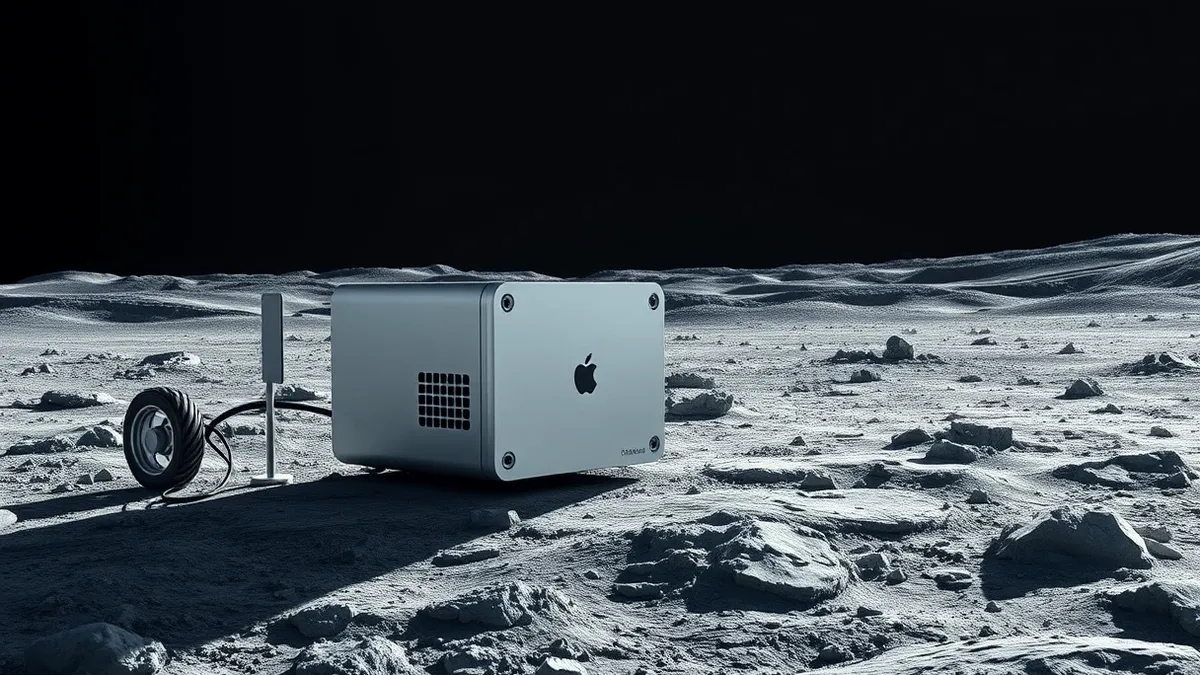
The Spaceborne Computer-4 is a fanless, self-contained compute module designed specifically for space environments rather than being an off-the-shelf solution like those used on the International Space Station. Norm Follett, HPE senior director, explained on the company’s Technology Now podcast that the blade is approximately 10 inches long and 4 inches wide.
The module consists of two component cards and includes 1TB of Kioxia storage, a low-power CPU, and a small GPU. The chassis is engineered to shed heat into a rover plate. HPE has not provided hard details on performance targets, power budgets, or specific chip vendors in its current description of the unit.
Scott Wiest, HPE’s vice president and global sales chief technologist, noted that the next chapter of lunar exploration depends on turning data into insights at the point of discovery. HPE describes this deployment as bringing AI and high-performance computing to the "lunar edge" or "far-edge."
Benchmarking and AI Workloads
The system will run High Performance LINPACK and High Performance Conjugate Gradients benchmarks, which are standard supercomputing metrics. In addition to traditional HPC tests, the module will perform AI testing involving large language model retrieval-augmented generation, vision inference, and LiDAR processing.
The AI services container will support AI application deployment. According to HPE, the large language models will deliver insights, analyze visual data, and support autonomous monitoring. LiDAR processing tasks will include mapping, navigation, terrain analysis, and infrastructure development support.
HPE assembled a software suite to handle the link to Earth-side systems and ensure the secure delivery of results. While the eventual benchmark results will yield information about the hardware's capabilities, the immediate goal is to validate these computing methods in a lunar environment.
What should you do?
Security professionals should monitor vendor announcements regarding hardware designed for extreme environments, as these often operate with unique security constraints. Organizations involved in space-related projects should review data transmission protocols for secure delivery from remote locations.
Background: Large language models
Large language models are a specific type of neural network trained on text. Generative AI is the broader umbrella term for any system that creates new content, including images and code. Not all generative AI uses large language models, but most modern text generators do.
What to do and how to stay safe: HPE
- Review data transmission protocols for secure delivery from remote or extreme environments.
- Monitor vendor announcements for hardware designed for specialized operational constraints.
- Assess the security implications of deploying AI models in disconnected or high-latency networks.
- Verify that remote monitoring systems have robust authentication and encryption standards.
Step-by-step guide: Prompt Injection Warning Signs: How to Spot AI Manipulation
General security guidance from the Threat Times newsroom. It is not confirmed advice from the organisations named in this story.
Frequently asked questions
When is the Spaceborne Computer-4 mission scheduled to launch?
The launch is slated for late 2026 under NASA’s Commercial Lunar Payload Services initiative.
What benchmarks will the computer run on the Moon?
It will run High Performance LINPACK and High Performance Conjugate Gradients, along with AI tests including large language model retrieval-augmented generation.
Who is providing the rover and lander for this mission?
The rover is provided by Astrolab, and the lander is provided by Voyager Technologies.