How Polymorphic Malware Works: The Step-by-Step Mutation Process
Polymorphic malware alters its code signature with every infection while keeping the underlying malicious logic intact, defeating static signature-based detection.

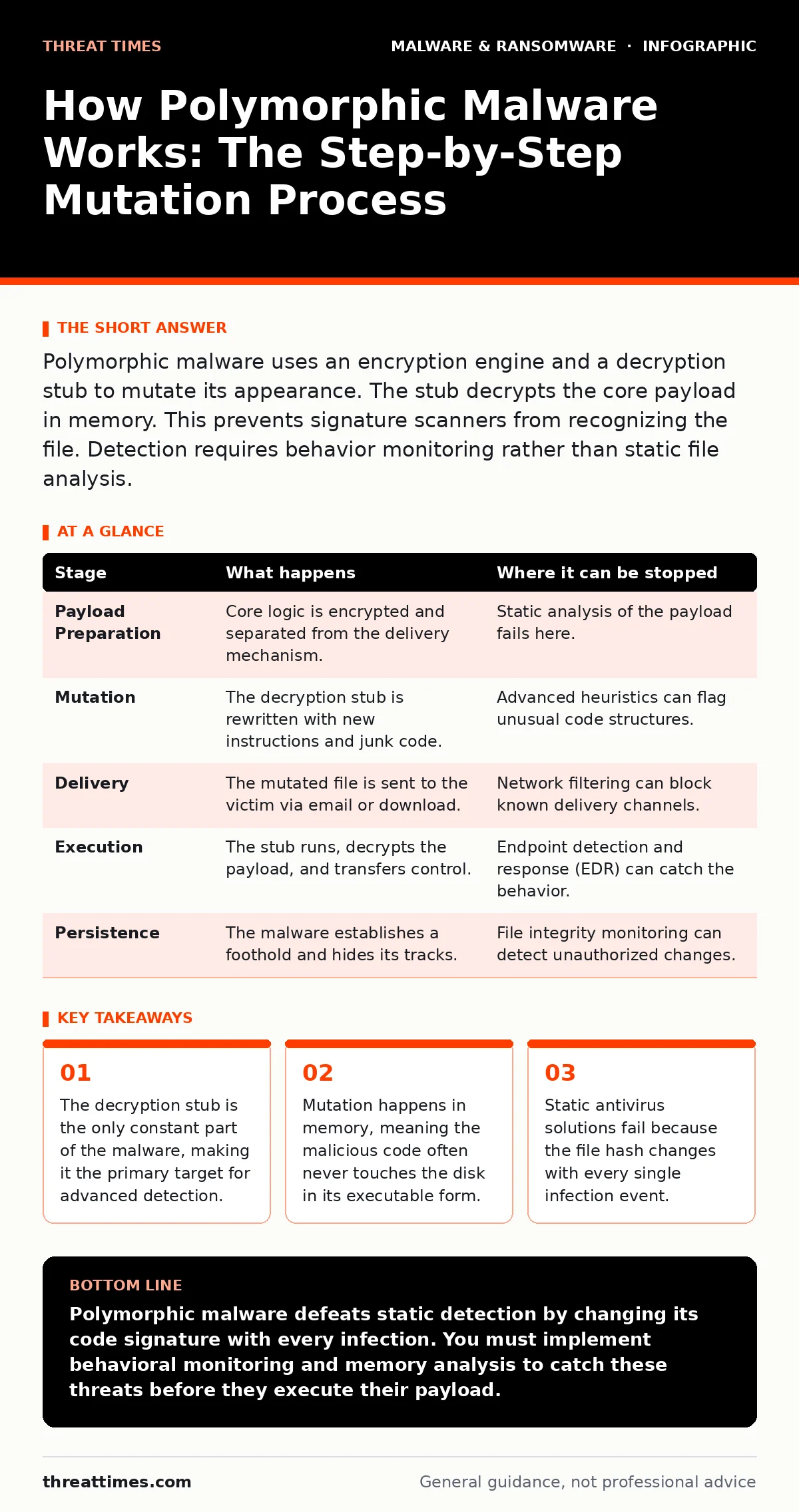
Polymorphic malware uses an encryption engine and a decryption stub to mutate its appearance. The stub decrypts the core payload in memory. This prevents signature scanners from recognizing the file. Detection requires behavior monitoring rather than static file analysis.
The Core Mechanism of Mutation
Polymorphic malware relies on a specific architectural split to survive detection. The attacker separates the malicious payload from the code that delivers it. The payload contains the actual instructions for data theft or system compromise. The delivery code is the mutable component. This design allows the malware to change its external appearance without altering its internal function.
The mechanism depends on encryption. The attacker encrypts the payload using a secret key. A small piece of code, known as the decryption stub, holds the key and the logic to unlock the payload. This stub is the only part of the malware that remains identical across different infections. All other parts change.
Stage 1: Payload Preparation
The attacker begins by writing the core malicious logic. This logic defines what the malware does once it runs. It might steal credentials, encrypt files, or open a command channel. This code is static and does not change. The attacker then encrypts this entire block of code.
The encryption process scrambles the data into an unreadable format. This ensures that simple file scanners cannot recognize the malicious instructions. The attacker selects a symmetric encryption algorithm for this step. Symmetric encryption uses the same key for locking and unlocking the data. This is faster and simpler than asymmetric methods.
The output is a ciphertext blob. This blob looks like random noise to any analyst or scanner. The attacker generates a unique decryption key for this specific instance. This key is stored within the decryption stub. The stub is small and efficient. It contains only the instructions needed to reverse the encryption process.
Stage 2: The Mutation Engine
Before the malware is sent to a victim, the mutation engine activates. This engine rewrites the decryption stub. It changes the instructions within the stub while preserving their function. The engine uses techniques like instruction substitution and register swapping.
Instruction substitution replaces one command with another that achieves the same result. For example, adding zero to a variable is functionally identical to doing nothing. The engine swaps these commands randomly. Register swapping changes which CPU registers hold specific data. The logic remains the same, but the binary representation changes completely.
The engine also inserts junk code. This is non-functional code that does nothing but take up space. It confuses disassemblers and human analysts. The junk code is placed between critical instructions. This breaks the visual pattern of the malware. The result is a new version of the stub that looks entirely different from the previous one.
| Stage | What happens | Where it can be stopped |
|---|---|---|
| Payload Preparation | Core logic is encrypted and separated from the delivery mechanism. | Static analysis of the payload fails here. |
| Mutation | The decryption stub is rewritten with new instructions and junk code. | Advanced heuristics can flag unusual code structures. |
| Delivery | The mutated file is sent to the victim via email or download. | Network filtering can block known delivery channels. |
| Execution | The stub runs, decrypts the payload, and transfers control. | Endpoint detection and response (EDR) can catch the behavior. |
| Persistence | The malware establishes a foothold and hides its tracks. | File integrity monitoring can detect unauthorized changes. |
Stage 3: Delivery and Initial Execution
The mutated malware is delivered to the target system. This often happens through a phishing email or a compromised website. The victim downloads the file. The file appears legitimate because its hash is unique. Previous versions of the malware were never seen before.
When the victim runs the file, the decryption stub executes first. The stub resides in the computer's memory. It does not write the decrypted payload to the hard drive. This avoids leaving a trace on the disk. The stub locates the encrypted payload in memory. It applies the decryption key stored within itself.
The decryption process reveals the original malicious code. This code is now in a runnable state. The stub then transfers control to this code. The payload begins to execute. The stub disappears from memory after this handoff. This makes forensic analysis difficult because the delivery mechanism is gone.
Stage 4: Payload Execution and Persistence
The decrypted payload now runs with full privileges. It performs its intended malicious actions. These actions might include scanning for sensitive files or establishing a connection to a command server. The malware operates in the background. It tries to remain invisible to the user and the operating system.
To maintain access, the malware establishes persistence. It modifies system settings to ensure it runs every time the computer starts. This might involve creating a new registry entry or scheduling a task. These changes are subtle. They blend in with normal system activity.
The malware may also attempt to disable security tools. It looks for known antivirus processes and terminates them. This reduces the chance of detection during the active phase. The malware continues to operate until the system is shut down or cleaned. The entire cycle can repeat if the malware spreads to other systems.
See also: Deception Technology Mistakes That Create False Sense of Security
Interrupting the Attack Chain
You can interrupt this process at several points. The delivery stage is the easiest to defend against. Network filters can block known malicious domains. Email gateways can scan attachments for suspicious content. However, these methods are not foolproof.
The execution stage requires behavioral analysis. Tools like endpoint detection and response (EDR) monitor processes rather than files. They look for unusual activity, such as a legitimate program launching a command shell. This approach catches polymorphic malware because the behavior remains constant even if the code changes.
The persistence stage is the last line of defense. File integrity monitoring detects unauthorized changes to system files. If a malware modifies a critical registry key, the system alerts the administrator. This allows for quick remediation. However, this method is reactive. The damage may already be done.
The Hidden Cost of Mutation
The mutation process introduces a hidden cost for the attacker. The decryption stub must be small and efficient. If it is too large, it becomes slower to execute. This increases the chance of detection by timing-based analysis. Attackers often optimize the stub to run as quickly as possible.
This optimization limits the complexity of the mutation. The attacker cannot use overly complex obfuscation techniques. This creates a predictable pattern in the stub's structure. Advanced security tools can identify this pattern. They look for the specific sequence of operations used to decrypt the payload.
You can exploit this weakness. By analyzing the common structure of decryption stubs, you can create generic detection rules. These rules do not rely on specific signatures. They look for the behavior of decrypting and executing code. This approach is more resilient against future mutations.
Advanced Detection Strategies
Static analysis is no longer enough. You must use dynamic analysis techniques. This involves running the malware in a controlled environment. You observe its behavior in real-time. This reveals the true nature of the payload.
Sandboxing is a common method for dynamic analysis. The malware runs in an isolated virtual machine. You monitor all system calls and network connections. This provides a complete picture of the malware's activity. However, sophisticated malware can detect sandboxes and alter its behavior.
You must also monitor memory activity. Polymorphic malware lives in memory. Traditional file scanners do not see this. Memory forensics tools can extract the decrypted payload from RAM. This allows you to analyze the malware even if it never touches the disk. This technique is critical for understanding the full scope of an infection.
Key takeaways
- The decryption stub is the only constant part of the malware, making it the primary target for advanced detection.
- Mutation happens in memory, meaning the malicious code often never touches the disk in its executable form.
- Static antivirus solutions fail because the file hash changes with every single infection event.
Polymorphic malware defeats static detection by changing its code signature with every infection. You must implement behavioral monitoring and memory analysis to catch these threats before they execute their payload.
Frequently asked questions
Can traditional antivirus software detect polymorphic malware?
Traditional antivirus relies on static signatures, which fail against polymorphic malware because the file hash changes. You need behavioral detection or heuristic analysis to identify the threat.
What is the difference between polymorphic and metamorphic malware?
Polymorphic malware encrypts its payload and mutates the decryption stub. Metamorphic malware rewrites its entire code, including the payload, making it even harder to detect.
How do I remove polymorphic malware from my system?
You must use specialized removal tools that can detect the behavioral patterns of the malware. Standard cleaning tools may miss the mutated components. Consult security experts for thorough removal.
Is polymorphic malware only used for ransomware?
No, polymorphic techniques are used in various types of malware, including spyware and trojans. Any malware that needs to evade detection can benefit from mutation.
How this guide was produced: written by the Threat Times editorial team with AI assistance, checked against the public references listed below, and reviewed when the facts change. See our editorial policy or report an error.