Rainbow Table vs Dictionary Attack: Key Differences and Defenses
Rainbow tables trade massive storage for speed, while dictionary attacks trade storage for flexibility and adaptability.

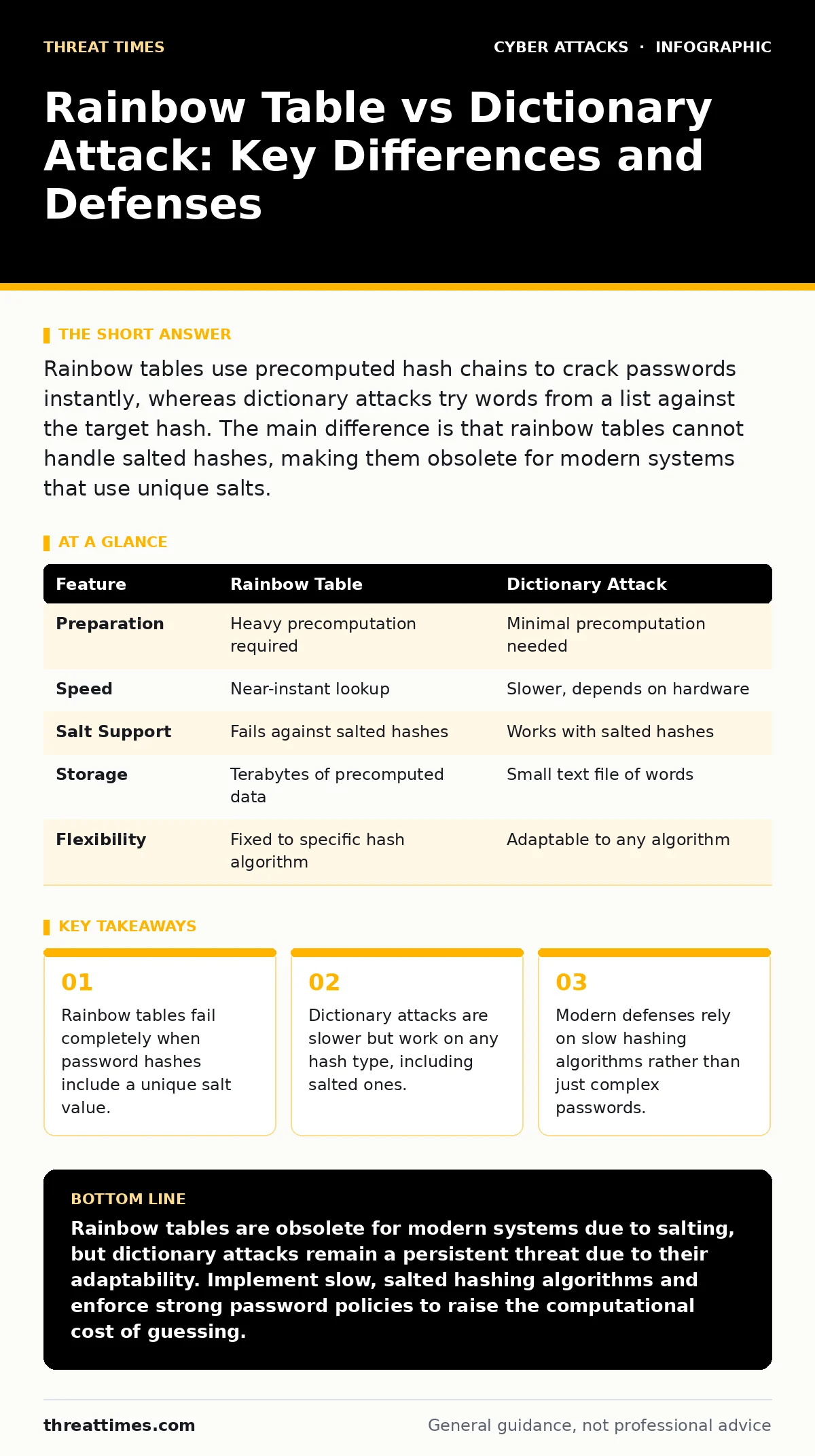
Rainbow tables use precomputed hash chains to crack passwords instantly, whereas dictionary attacks try words from a list against the target hash. The main difference is that rainbow tables cannot handle salted hashes, making them obsolete for modern systems that use unique salts.
What is the difference between rainbow table and dictionary attack?
The difference between rainbow table and dictionary attack lies in preparation versus execution. A rainbow table is a precomputed lookup structure that maps hash values back to their original passwords, allowing immediate retrieval without calculation. A dictionary attack generates hashes on the fly by running words from a list through the target hashing algorithm. You choose between speed using stored data or flexibility using real-time computation.
How does a rainbow table actually work?
Rainbow tables rely on the mathematical concept of hash chains to compress storage. Instead of storing every possible password and its hash, the table stores only the start and end points of long chains of alternating passwords and hashes. When you find a matching hash in the chain end, you recompute the chain from the start to find the original password. This method reduces storage requirements by orders of magnitude compared to simple lookup tables.
Why do rainbow tables fail against salted hashes?
Rainbow tables require identical inputs to produce identical outputs, which salted hashes prevent. A salt is a random string added to a password before hashing, ensuring that two users with the same password produce different hash results. Because the salt changes the input, the precomputed chains in a rainbow table no longer match the target hash. You would need a separate rainbow table for every possible salt value, which is computationally impossible.
| Feature | Rainbow Table | Dictionary Attack |
|---|---|---|
| Preparation | Heavy precomputation required | Minimal precomputation needed |
| Speed | Near-instant lookup | Slower, depends on hardware |
| Salt Support | Fails against salted hashes | Works with salted hashes |
| Storage | Terabytes of precomputed data | Small text file of words |
| Flexibility | Fixed to specific hash algorithm | Adaptable to any algorithm |
What makes dictionary attacks persistent threats?
Dictionary attacks remain effective because they adapt to modern defenses like salting. Since the attacker generates hashes in real time, they can append the known salt to each dictionary word before hashing. This allows the attack to proceed against any system, regardless of how the hash is constructed. The bottleneck is purely computational power and the size of the word list, not the structure of the hash itself.
How do hybrid attacks combine these methods?
Hybrid attacks merge the breadth of dictionary attacks with the depth of brute-force techniques. Attackers take a base word from a dictionary and apply common transformations, such as appending numbers or capitalizing letters. This approach captures the human tendency to create predictable variations of simple words. You face a threat that is smarter than pure brute force but more flexible than a static rainbow table.
Why are modern hashing algorithms designed to be slow?
Slow hashing algorithms increase the cost of every guess an attacker makes. Algorithms like bcrypt, scrypt, and Argon2 intentionally require significant memory and processing time to compute a single hash. This slows down dictionary attacks by forcing the attacker to wait seconds or minutes per guess rather than microseconds. Rainbow tables become even less useful because precomputing millions of slow hashes is economically and practically unfeasible.
What role does password length play in defense?
Password length exponentially increases the search space for any attack method. A short password, even if complex, has fewer possible combinations than a long passphrase made of simple words. Dictionary attacks rely on common words, so a random string of characters outside the dictionary defeats them. However, length alone does not stop an attacker with unlimited time; you must combine length with slow hashing to raise the barrier high enough to deter most efforts.
How do you mitigate these attacks effectively?
Mitigation requires a layered approach that addresses both the attack vector and the underlying credential management. First, ensure your system uses a modern, slow hashing algorithm with per-user salts. Second, enforce password complexity rules that discourage dictionary words. Third, implement account lockout policies after a small number of failed attempts to halt automated guessing. Finally, consider privileged access management solutions to limit the impact of any compromised credentials.
Can social engineering bypass these technical defenses?
Technical defenses like slow hashing and salts only protect the stored hash, not the initial password creation. If an attacker obtains your password through social engineering or phishing, they do not need to crack the hash at all. They can simply use the password directly to access the account. This highlights why security culture is as important as cryptographic strength; a strong hash cannot protect a password that was willingly given away.
Key takeaways
- Rainbow tables fail completely when password hashes include a unique salt value.
- Dictionary attacks are slower but work on any hash type, including salted ones.
- Modern defenses rely on slow hashing algorithms rather than just complex passwords.
Rainbow tables are obsolete for modern systems due to salting, but dictionary attacks remain a persistent threat due to their adaptability. Implement slow, salted hashing algorithms and enforce strong password policies to raise the computational cost of guessing.
Frequently asked questions
Are rainbow tables still used by hackers?
Rainbow tables are rarely used today because most systems use salted hashes, which invalidate precomputed tables. Attackers prefer online dictionary attacks or offline brute force with modern hardware.
Can a dictionary attack crack a hashed password?
Yes, if the password is in the attacker's dictionary list and the hashing algorithm is fast enough. The attacker hashes each word from the list and compares it to the stolen hash.
Does changing the hash algorithm stop dictionary attacks?
Changing to a slower algorithm like bcrypt or Argon2 significantly slows down dictionary attacks, making them impractical for large-scale breaches. It does not stop them entirely but raises the cost.
How do I know if my system is vulnerable to rainbow tables?
Your system is vulnerable if it uses unsalted hashes. Check your configuration to ensure every password hash includes a unique, random salt value stored alongside the hash.
How this guide was produced: written by the Threat Times editorial team with AI assistance, checked against the public references listed below, and reviewed when the facts change. See our editorial policy or report an error.