AMD unveils Helion Agentic AI Rack with 32,768 cores for specialized workloads
The new rack-scale system combines Zen 6 CPUs and Instinct accelerators, potentially requiring infrastructure upgrades for traditional data centers.
Key points
- The Helion Agentic AI Rack supports up to 32,768 Zen 6 CPU cores and 16 Instinct MI350P accelerators.
- AMD categorizes agent workloads into personal, enterprise, and technical computing groups with distinct hardware needs.
- Traditional data centers may need to upgrade power and cooling infrastructure to support this high-density configuration.
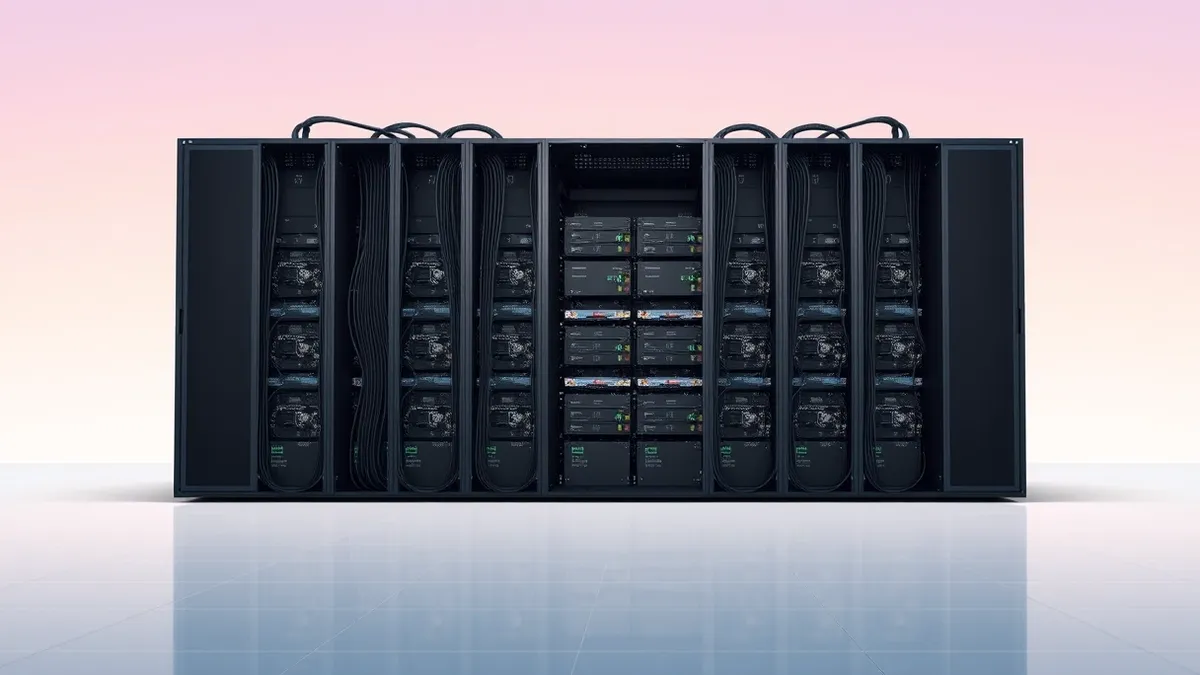
AMD announced the Helion Agentic AI Rack, a new rack-scale computing system designed specifically for artificial intelligence agents. According to TechRadar, the platform combines high-core-count processors with accelerators and programmable networking capabilities. This release targets operators who need to handle diverse agent workloads within a single, modular hardware framework.
The proposed system delivers up to 32,768 Zen 6 x86 CPU cores alongside 16 Instinct MI350P accelerators. TechRadar reports that the rack provides 74 petaflops of FP4 computing performance and supports 102 Tbps of networking bandwidth. The hardware is modular, allowing operators to customize CPU core density, processing performance, and power consumption based on specific workload requirements.
Workload Categories and Hardware Configurations
AMD divides agent workloads into three distinct categories: personal assistants, enterprise applications, and technical computing. Each category has unique processing requirements that dictate the hardware configuration. Personal agents prioritize dense, energy-efficient servers, while enterprise applications require a balance between agent capacity and overall performance. Technical workloads focus primarily on processing speed and computational intensity.
For personal agent workloads, the system utilizes 256-core Venice processors operating at 400W. This configuration prioritizes processing density and power efficiency for individual user tasks. Enterprise workloads use 256-core Venice processors rated at 600W, providing a higher power ceiling for more demanding corporate applications. The enterprise setup separates agent execution, inference, and general-purpose computing into distinct server nodes for better resource management.
Technical computing configurations employ 96-core, high-frequency Venice processors to maximize speed for complex calculations. In the enterprise version, CPU sandbox nodes handle agent execution, while Instinct MI350P accelerators support inference tasks. General-purpose servers accommodate databases, storage, and technical computing functions. AMD also includes an integrated token router to direct agent model requests across both frontier and open-source models.
Infrastructure Implications for Data Centers
The Helion Agentic AI Rack supports programmable networking and an open-source software ecosystem. The hardware complies with Open Compute Project specifications, specifically the ORv3 44OU standard. However, TechRadar notes that traditional data centers may need substantial changes to accommodate this new equipment. Legacy facilities are typically built for standard cloud or enterprise computing, not racks packing tens of thousands of cores.
Traditional infrastructure may lack the necessary power delivery and cooling capacity for such high-density configurations. Operators deploying the hyperscale configuration might use CPU-only infrastructure, while the enterprise version integrates processors and graphics accelerators. This integration increases the thermal and power demands on the physical data center environment. Facilities must assess their current power and cooling limits before deploying these dense racks.
What should you do?
Security and infrastructure professionals should review their current data center power and cooling capacities against the requirements of high-density AI racks. Organizations planning to deploy agentic AI workloads should evaluate whether their existing facilities can support the thermal output of systems like the Helion rack. IT leaders should also assess their networking bandwidth capabilities to ensure they can handle the 102 Tbps throughput mentioned in the specifications.
What to do and how to stay safe: AMD
- Audit current data center power and cooling infrastructure to determine if it can support high-density AI racks with thousands of cores.
- Evaluate networking bandwidth capabilities to ensure the facility can handle the high throughput required by programmable networking in AI racks.
- Review workload requirements to determine if personal, enterprise, or technical computing configurations best fit the organization's AI agent needs.
- Monitor vendor updates for compliance with Open Compute Project specifications to ensure hardware interoperability and standardization.
Step-by-step guide: Prompt Injection Warning Signs: How to Spot AI Manipulation
General security guidance from the Threat Times newsroom. It is not confirmed advice from the organisations named in this story.
Frequently asked questions
What is the maximum CPU core count supported by the Helion Agentic AI Rack?
The rack supports up to 32,768 Zen 6 x86 CPU cores, according to TechRadar.
How many AI accelerators are included in the proposed system?
The system includes 16 Instinct MI350P accelerators alongside the CPU cores.
What are the three categories of agent workloads defined by AMD?
AMD groups agent workloads into personal assistants, enterprise applications, and technical computing.