Open-source simulator models Commodore 64 hardware faults pin by pin
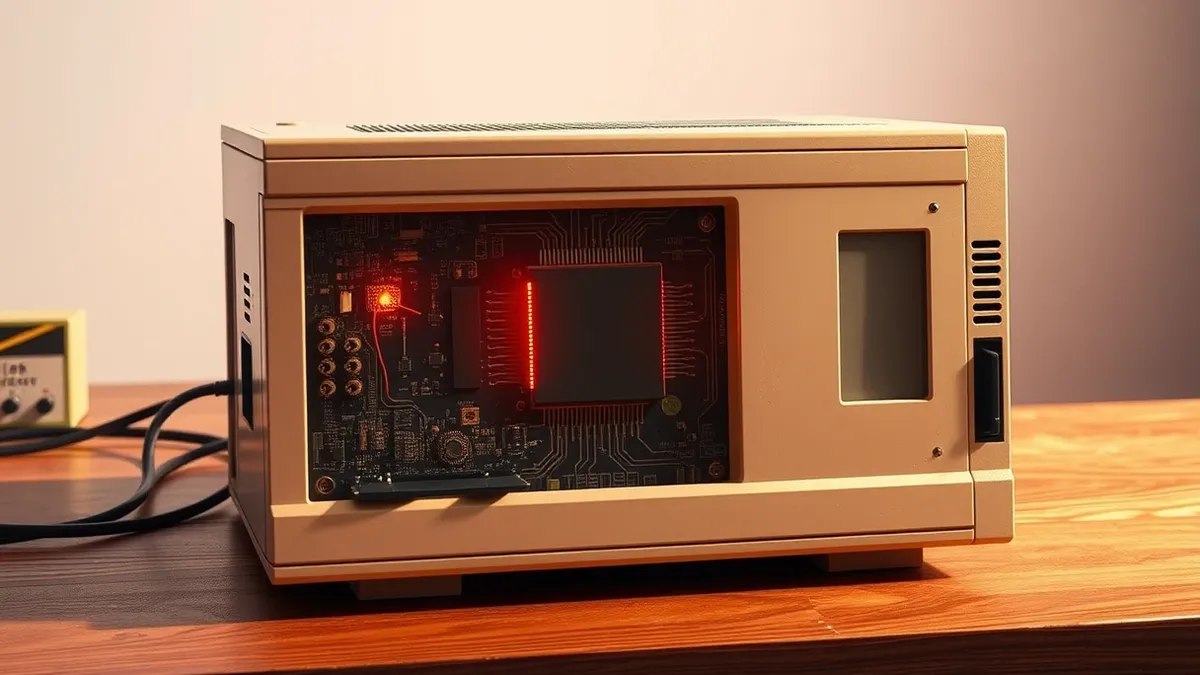
A new hardware simulator allows users to break virtual chips on the Commodore 64 motherboard to study circuit behavior without risking physical damage.
Key points
- The simulator models the ASSY 250407 motherboard pin by pin using known netlists and chip behaviors.
- Users can simulate faults like lifted pins or removed chips to diagnose broken hardware or learn architecture.
- The program runs slower than real-time on modern hardware and is not intended for gaming emulation.
Antirez has released an open-source hardware simulator that models the Commodore 64 motherboard at the pin level. The tool allows users to simulate physical faults, such as lifted pins or removed chips, to observe how the machine reacts without risking damage to actual vintage hardware.
The simulator focuses on the ASSY 250407 motherboard revision. It uses the board's netlist and known chip pin behaviors to compute results. The program does not contain pre-recorded outputs for broken states. Instead, it calculates how signals change when components fail, generating screen garbage or other symptoms directly from the circuit logic.
Technical capabilities and limitations
Users can simulate specific hardware interventions, including lifting a chip leg, shorting it to ground or +5V, pulling a chip from its socket, or opening a resistor. The simulator tracks the monitor output, keyboard input, and every signal on the board. For example, lifting pin 17 of the color RAM before power-on causes the CPU and VIC to use the same wrong address, aliasing the RAM. Restoring the pin reveals random colors from unwritten memory.
The developer notes that the simulator is computationally intensive. It runs at 31% of real-time speed on an Apple M3 Max, 39% on an AMD Ryzen AI Max+ PRO 495, and 48% on an Apple M5 Max. This performance limitation means the tool is not suitable for playing games at full speed. It is designed for analysis and education rather than entertainment.
Diagnostic and educational use cases
The primary use cases are learning the Commodore 64's internal workings and diagnosing broken units. For students, the tool offers an intimate look at circuit behavior that is difficult to reproduce on real hardware without risking damage. Many vintage boards have soldered chips, making physical experimentation risky. For repairers, the simulator helps test hypotheses about broken components.
Simulating a fault can provide clues that help technicians desolder chips in a logical order. This approach minimizes the number of chips removed, reducing the risk of board damage during the tedious desoldering process. However, the developer warns that a matching symptom is a clue, not proof. Different faults can produce similar visual results, and the simulation has inherent limits.
What should you do?
Security and technology professionals interested in hardware emulation or reverse engineering can explore the code on GitHub. The project demonstrates how detailed circuit modeling can aid in understanding legacy systems. Users should be aware that the tool requires significant computational power and is not a drop-in replacement for standard emulators.
What to do and how to stay safe: Commodore 64
- Review the GitHub repository to understand the netlist and chip behavior models used in the simulation.
- Test the simulator on high-performance hardware to evaluate its speed limitations for your specific use case.
- Use the tool to hypothesize fault conditions before attempting physical repairs on valuable vintage hardware.
- Verify simulation results against known hardware behaviors, as different faults may produce similar symptoms.
Step-by-step guide: Mobile Device Security: How to Protect Data Beyond Passwords
General security guidance from the Threat Times newsroom. It is not confirmed advice from the organisations named in this story.
Frequently asked questions
Can this simulator be used to play Commodore 64 games at full speed?
No, the simulator runs significantly slower than real-time on modern hardware, making it unsuitable for gaming.
Does the simulator contain pre-recorded outputs for broken hardware states?
No, the program computes all results from the circuit logic and netlist, without any pre-recorded broken states.
Which motherboard revision does the simulator model?
The simulator models the Commodore 64 ASSY 250407 motherboard revision, simulating it pin by pin.