NVIDIA Releases Factory Operations Blueprint on GitHub for European Industrial AI Agents
The new open-source framework enables developers to build and deploy factory manager agents that coordinate machinery and analyze operations in real time.
Key points
- NVIDIA released the Factory Operations Blueprint (FOX) in early access on GitHub to support industrial AI agent development.
- Siemens reports estimated cost savings of 20% and a 40% reduction in calibration time using FOX-based agents at its Erlangen facility.
- New CUDA-X library cuDSS reaches general availability to accelerate structural and fluid simulations for engineering teams.
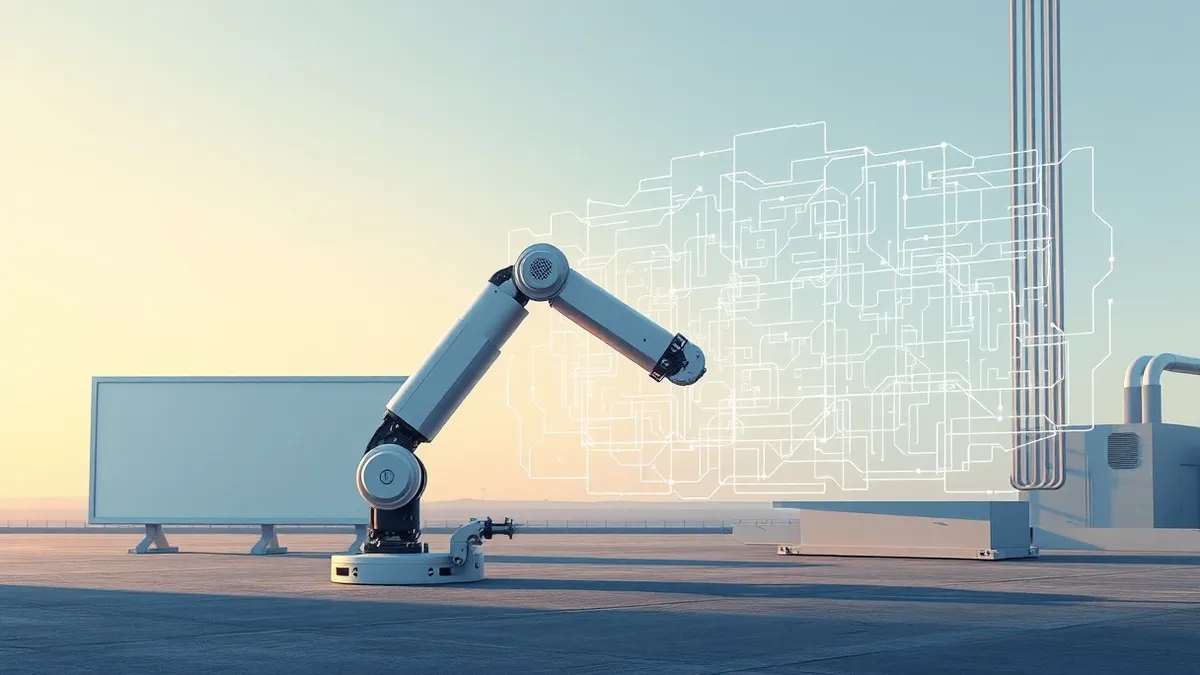
NVIDIA published the Factory Operations Blueprint on GitHub in early access, providing a foundation for developers to build industrial AI agents. The framework connects factory floor systems with open models like Cosmos and Nemotron, enabling automated coordination of machinery and specialized tasks such as visual inspection and root cause analysis.
These agents leverage NVIDIA’s CUDA-X and Omniverse libraries to monitor operations in real time. They can correlate visual data with machine logs to investigate problems without requiring fine-tuning, thanks to Cosmos in-context learning capabilities. The blueprint allows organizations to deploy always-on manager agents that oversee broader factory workflows alongside specialist agents focused on specific use cases.
Enterprise Adoption and Simulation Speedups
Siemens is integrating FOX-built agents into its Intelligence Center X system to coordinate factory operations and identify root causes. The company estimates these changes will yield cost savings of 20%. At its Erlangen electronics plant, Siemens used NVIDIA Cosmos Data Factory tools to generate defect images for circuit-board inspection, reducing calibration time by 40%.
Mercedes-Benz utilizes Siemens’ Simcenter STAR-CCM+ on NVIDIA GPUs for faster aerodynamic simulations of vehicle designs. The automaker also applies NVIDIA Cosmos 3 and the Metropolis VSS blueprint to build agents for vehicle inspection and windshield assembly verification, ensuring consistent quality by detecting deviations during manufacturing processes.
Cadence is benchmarking automotive fluid-dynamics workloads on NVIDIA GPUs to evaluate opportunities for faster design iteration. Autodesk has integrated NVIDIA PhysicsNeMo and Warp frameworks into its NavPack software, which works with Autodesk Alias. This integration helps designers at companies like Bentley predict vehicle performance and iterate more quickly using simulation-trained artificial intelligence.
Semiconductor and Aerospace Engineering Applications
imec and Infineon are accelerating semiconductor simulations using Synopsys software and NVIDIA accelerated computing. Benchmarks of S-Litho on imec’s model showed up to a 40x speedup. Infineon achieved a 12x speedup in 3D breakdown simulation for next-generation power devices by using Sentaurus Device with NVIDIA CUDA libraries.
Leonardo is collaborating with Neural Concept on AI-driven aircraft design, using NVIDIA Omniverse libraries to combine aircraft geometry with aerodynamic simulation results. Car manufacturers are employing Dassault Systèmes’ LEO & AURA Virtual Companions, powered by NVIDIA Nemotron, to rapidly design and virtually test vehicle doors before constructing physical prototypes.
UniversalAGI is working with Saab to protect sailors from dangerous wave impacts using physics AI foundation models. By leveraging NVIDIA Warp for accelerated processing, the system evaluates thousands of wave conditions and headings in real time, a task that previously took days to complete.
What should you do?
Security and technology professionals should monitor the NVIDIA GitHub repository for updates to the Factory Operations Blueprint. Organizations using industrial IoT systems should review their network segmentation strategies to ensure that new AI agents are properly isolated from critical operational technology networks.
What to do and how to stay safe: NVIDIA
- Review the NVIDIA Factory Operations Blueprint documentation on GitHub to understand the data requirements for connecting AI agents to factory systems.
- Audit current operational technology networks to identify potential vulnerabilities that could be exposed by integrating always-on AI monitoring agents.
- Evaluate whether existing IT and OT security policies account for real-time data correlation between visual inspection tools and machine logs.
- Plan for the integration of new simulation libraries like cuDSS by assessing current GPU infrastructure capacity for accelerated engineering workloads.
Step-by-step guide: Mobile Device Security: How to Protect Data Beyond Passwords
General security guidance from the Threat Times newsroom. It is not confirmed advice from the organisations named in this story.
Frequently asked questions
What is the NVIDIA Factory Operations Blueprint?
It is an open-source framework released on GitHub that helps developers build and deploy AI agents to coordinate factory operations and analyze industrial data.
Which companies are using NVIDIA's new industrial AI tools?
Siemens, Mercedes-Benz, imec, Infineon, Leonardo, UniversalAGI, and Saab are among the organizations leveraging these technologies for simulation and operations.
Does NVIDIA provide a fix for security vulnerabilities in these tools?
The source material does not mention any security vulnerabilities or patches; it focuses on the release of new software capabilities and performance improvements.